Skip to: Course Modules Tutor Price FAQs
CONTEMPORARY ART, FROM THE GROUND UP.
Create sustainable textile art using earth pigments with Claire Benn.
Enrolment closes 21 September | Places are limited
ONLINE ART COURSE
DIRECT TUTOR FEEDBACK
PRIVATE COMMUNITY
LIFETIME ACCESS
From earth pigment to finished cloth, this is abstract contemporary fibre art with Claire Benn
A sustainable art practice shouldn’t compromise on quality and colour.
There’s a reason many artists stick with acrylics and synthetic binders: they’re consistent and easy to access.
But for many artists those benefits stop being enough, especially if you want to:
- Feel connected to your materials.
- Reduce waste.
- Avoid harsh chemicals.
- Create fibre artwork that reflects your values.
In Out of This Earth, everything comes out of the ground: pigment you can source yourself, bound to cloth with soya milk you make.
Claire Benn collecting pigment in Wadi Rum, Jordan
Working with earth pigments is a direct connection back to the land.
– CLAIRE BENN
Earth pigments and soya:
Good for the earth. Gorgeous on cloth.
Start with dirt in a jar. Learn to process both foraged and bought earth pigment by hand, ready for your cloth.
Make your own soya milk from raw beans and use it to bind the pigment to cloth – no synthetic mediums, no acrylic binders.
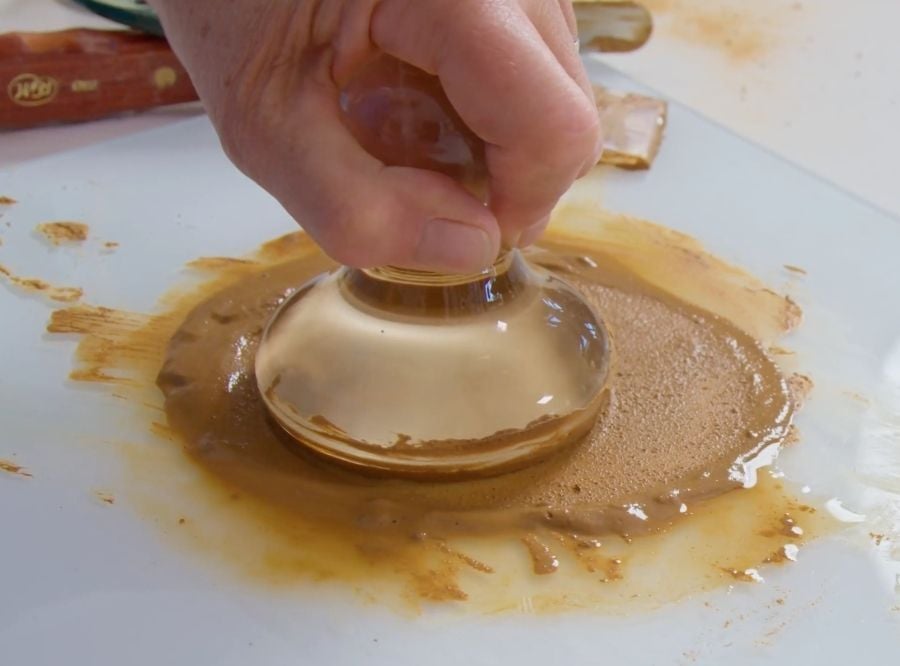
Lay down your first liquid soya and pigment paint and see how it settles into organic shapes – often similar to the shapes of where the pigment was collected.
Work with resists and textural surfaces, building layers only you would choose, and on cloth only you have touched.
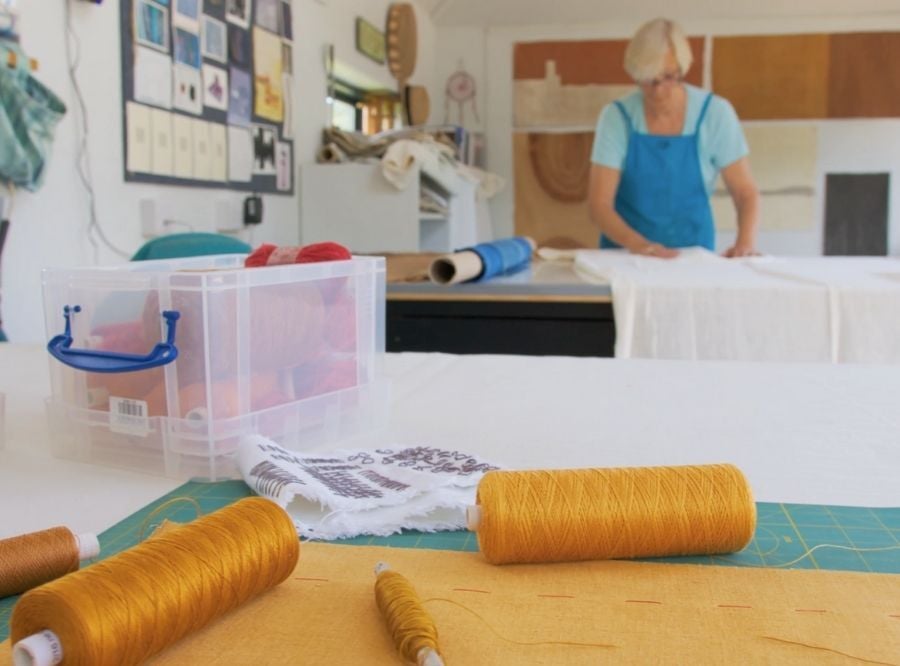
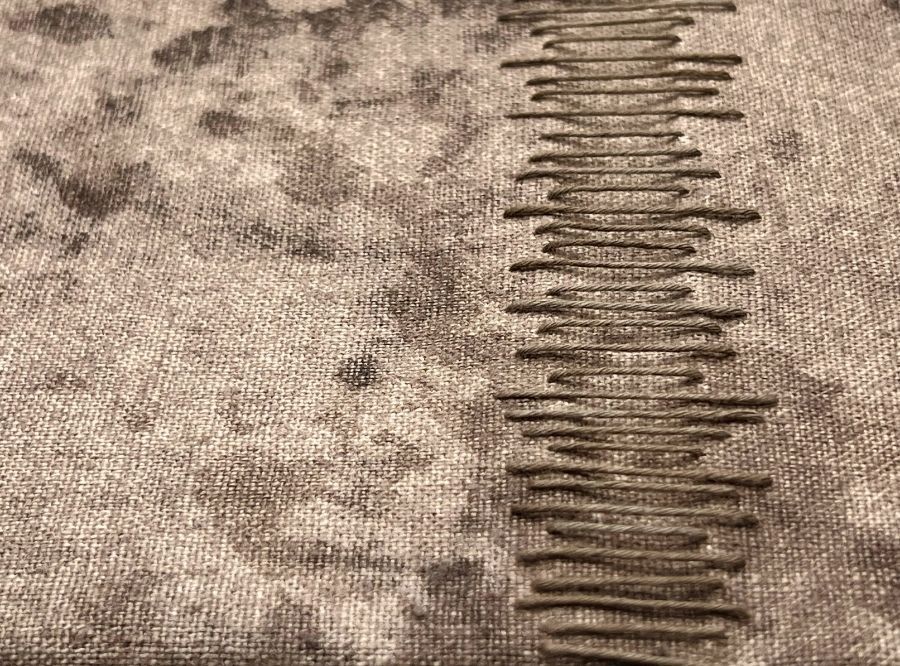
Bring stitch back into your practice as a considered, meditative finishing process – adding presence, not decoration.
Move from experimentation to intentional, exhibitable artwork with Claire’s approach to composition and proportion.
Enrolment closes 21 September Places are limited
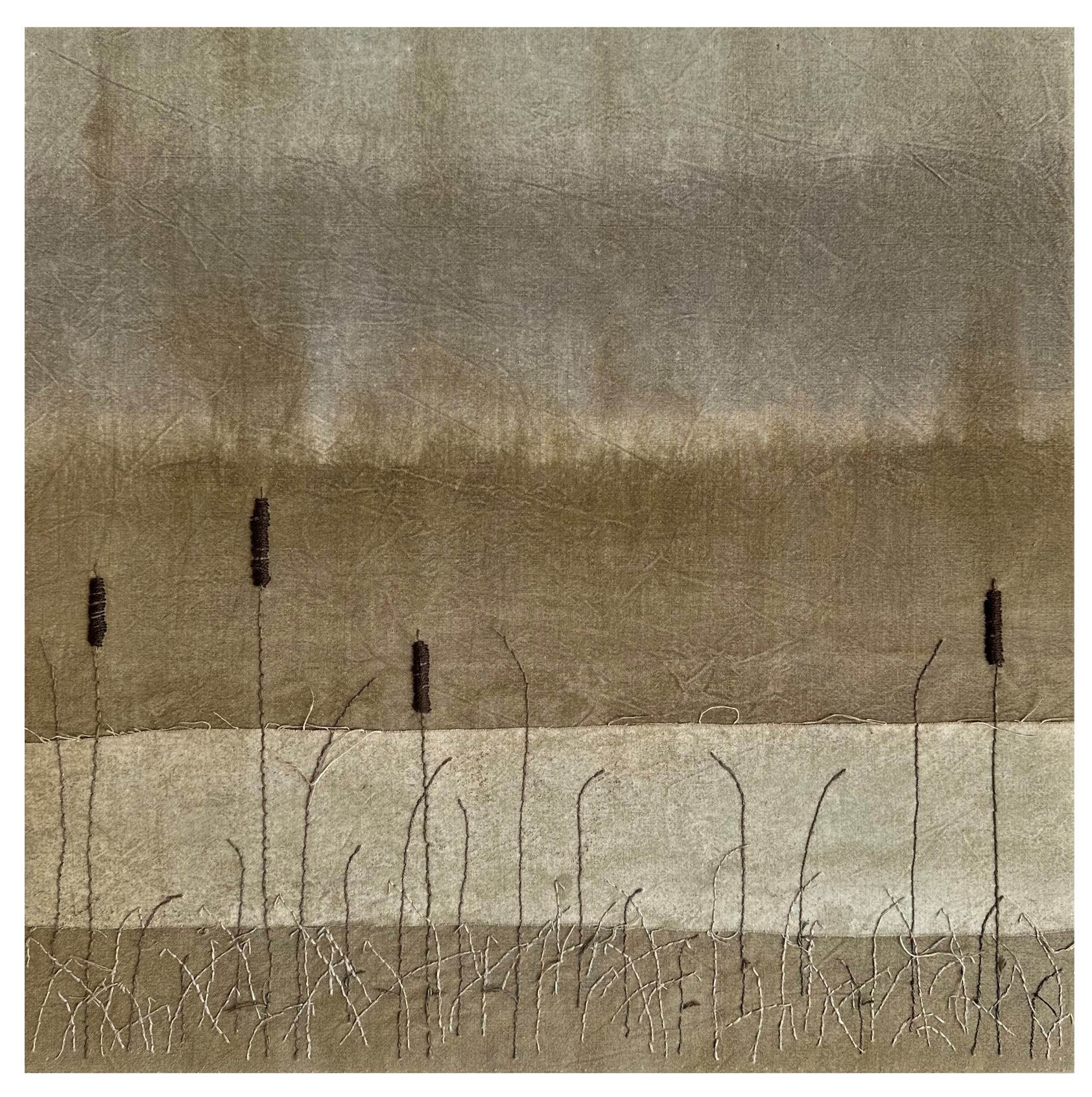
Previous student work from Claire’s course
Learning to use materials that make my art practice more sustainable was my primary goal with this course. The bonus was spending time soaking up the philosophical and conceptual investigations Claire's brilliant teaching style provided.
The course has had a profound impact on my current art practice. It taught me the beauty of simplicity in my work. By using earth pigments, I learned to appreciate the subtle nuances and earthy tones that can create powerful visual impact.
This course has given me a wealth of knowledge on pigment-to-cloth techniques, as well as a clearer understanding of how pigments behave on paper. I've come away with a whole new set of tools to enrich my mixed media practice.
Out of This Earth helped me further my art practice. I love working with new materials and techniques and I now feel as if I have a solid handle on working with earth pigments. It’s a technique I'm sure I’ll utilize – alone or in conjunction with other materials/techniques – as I create new work.
This course has been such a rich personal experience. Claire's teaching focus and mentoring have given me such a solid foundation and combined with Donna Watson's Masterclass I feel in a totally different creative space.
Do it! You will not regret it. You learn so much. Not just the technique of Earth Pigments, but lots more about design and process as an artist.
This course is your missing link to the world’s oldest source of colour.
Claire Benn is a respected UK-based textile artist, author and educator with 20+ years’ international experience. In 2013, she gave herself permission to make the quiet, reductive work that inspires her, after encountering Agnes Martin's work – and she’s never looked back.
Since then, her practice has centred on raw earth pigment: with both commercially available ones, and soil and clay from her garden, walks, and places that matter to her. She's carried that as far as the Atacama Desert, using pigment she foraged there in her exhibited work.
For Claire, the earth you stand on becomes the surface you work with.
I believe that by spending time with your work, to sit and look, to sit and contemplate, you get more considered work, and I think you put more of yourself into it, and somehow that shows up in your artwork.
Stitch slows me down, and when I hand stitch it is a meditation to experience any given moment.
- CLAIRE BENN
Claire Benn is a wonderful tutor, who generously shares her time, expertise and knowledge. Claire's teaching style is inclusive, supportive and encouraging and provides students with the confidence to explore new ways of working.
I have never had a teacher who went so far above and beyond the parameters of the course to touch every single student no matter their experience. I have learned so much about technique, materials I would have otherwise been too intimidating to explore, style and composition.
Claire is an excellent guide to learn technical skills, but for me the most valuable learning came from her encouragement to break with preconceptions and move past boundaries that present themselves.
Claire, you have given me lots to think about in terms of an evolving stitch vocabulary and simplifying towards abstraction. Thank you for all that you share and your hard work and dedication to your art and all your students.
It's Claire herself. It's her presentation style... as if she’s talking right to you. Her sense of humor and straightforward forward delivery of content that she cares deeply about, makes her a gem of a tutor!
I found Claire to be a very honest teacher. Nothing is hidden, mistakes and all. She’s very encouraging for further exploration and finding your own appreciation of your mark.
-
Module one: Cloth and pigment
Claire says that letting go of the outcome is absolutely vital. Module one begins with the fundamentals of raw pigment on cloth.
You'll learn:
- To think about your source of inspiration and what you want to visually communicate through your art.
- How to choose and prepare cloth that successfully takes earth pigment.
- To process a foraged or bought pigment by hand, from raw material to usable colour.
- Pigment properties, including the pros and cons of working on pre-coloured cloth vs plain cloth.
-
Module two: Soya beans to milk
Making your own soya milk from raw beans is the foundation of Claire’s art-making process. Learn why soya works, and how to pre-size cloth with it.
You’ll learn:
- Why soya milk is the binder of choice – and what makes it more effective than store-bought alternatives.
- How to make soya milk from scratch, on demand, whenever a project needs it.
- How to pre-size cloth so pigment bonds, rather than sitting on the surface, for consistent, reliable results.
- Prepare to make your first batch of pigment paint – affectionately referred to as Soy-Pig.
-
Module three: Making soya paint
By the end of this module, you’ll have made your own first batch of soya paint.
You’ll learn:- How to measure and adjust the soya milk-to-pigment ratio to suit your preferences.
- To mix raw earth or synthetic pigments with soya milk to create your own liquid soya paint.
- The importance of colour swatching as a tool for consistency and creative reference.
- Ways to explore the visual and tactile differences between synthetic and earth pigments in the mixing process.
- Be ready to begin your first application experiments – with colour you’ve created yourself.
-
Module four: Basic application methods
It’s time to paint your first layer of colour with liquid soya paint. You’ll begin exploring application methods, and start noticing how different choices affect the results.
You’ll learn:
- How to apply pigment on both damp and dry cloth, and why it matters.
- To explore the ways drying time, pressure, and cloth texture influence your outcomes.
- To develop your own preferences – from smooth coverage to organic, textured marks.
- To use a surface residue method to ensure nothing is wasted in your early explorations.
- Walk away with your first coloured cloth – and likely, a dozen new ideas to try next.
-
Module five: Using absorbent thieves
Learn one of Claire’s signature techniques – using “thieves” to draw pigment through the cloth in subtle, unexpected ways. It’s a process that builds on your understanding of pigment weight and reveals the responsiveness of this medium.
You’ll learn:- How pigment density (or specific gravity) affects how colour moves through cloth.
- To use absorbent resists to deliberately remove pigment, not just add it.
- Gain a second way of shaping a surface, beyond simply painting it on.
- Conduct three to four guided experiments to see how different variables impact your results.
- Understand how environmental factors like humidity can influence your outcomes.
- Discover new ways to create soft, layered effects and organic design elements.
-
Module six: Using non-absorbent resists
Explore how resists hold colour back both above and below the cloth – building contrast and structure into your surface. This is where the versatility of the medium really starts to shine.
You'll learn:
- How to work with different types of resists and understand which ones perform best with soya-based pigment paint.
- Experiment with layering colour and see how resists affect tone, texture, and coverage.
- Explore how Indigo behaves over soy-pigmented surfaces.
- Discover how this method virtually eliminates bleeding – while creating space for cleaner, more deliberate results.
- Add two new surface design techniques to your toolkit using both resists and residue.
-
Module seven: Exploring textural surfaces
This is your chance to get outside, explore your surroundings, and let place become an intrinsic part of your work.
You’ll learn:
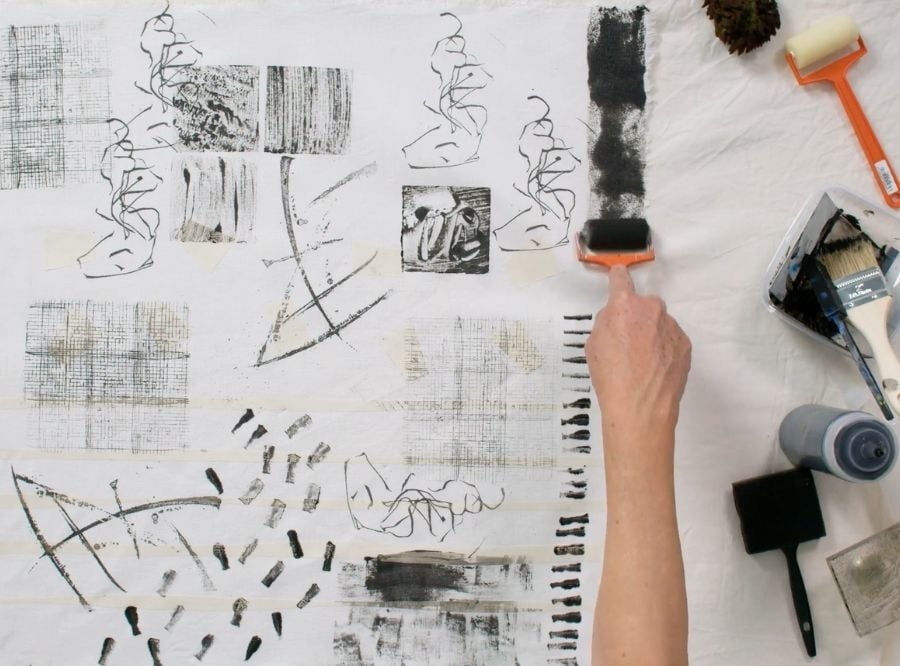
- A full toolkit of textural techniques — paste, thickened paint, pigment sticks, fine line.
- How to build a simple, portable toolkit for working outdoors whilst joining Claire on location (virtually) .
- Techniques for picking up surface textures from stone, rusted metal, brick, and more.
- Experiment with layering those textures into your cloth using natural, intuitive methods.
- To layer applications with real depth, rather than a single flat wash of colour.
- Start to think differently about your environment – translating it into mark, shape, and pattern.
-
Module eight: Cloth to cloth transfer
Explore how to transfer pigment directly from one layer of cloth to another – creating surprising effects that reveal the depth and weight of the medium. It’s one of the most distinctive processes in Claire's practice.
You’ll learn:
- How to use a double stack of cloth to transfer pigment from one surface to another.
- Which types of cloth work best for this method – and the ones to avoid.
- Combine techniques from previous modules to develop your own layered, responsive approach.
- To experience the joy of experimentation – like Claire did when she first discovered this method (she made nine samples in one sitting!)
-
Module nine: Adapting the media and other approaches
Let’s be honest. It wouldn’t be a Claire Benn course without a section on mark marking! And although we don’t consider this course a surface design course, it’s exciting to know what’s possible with Soy-pig paint. Learn about coverage and opacity, how to layer with intention, and the variables that change your outcome.
You’ll learn:
- To let loose, experiment and play using a wide variety of mark-making tools.
- See the similarities your Soy-pig cloth has to paper and learn to exploit the benefits.
- How to thicken soya milk into a paste to make thickened soya paint.
- To relish in the amazing results when it comes to working with fine lines, thermofaxes and silk screens.
-
Module ten: Final processes
Now the wet processes are done, Claire walks you through the final steps of preparing your cloth – post-size and cure. Understanding exactly how each choice affects the finished surface makes a big difference in your final artwork.
You’ll learn:
- To decide whether to wash your cloth or leave the pigment as-is.
- About post-sizing: what it is, when to use it, and why it matters.
- To understand curing times and how to test for colour fastness.
- Gain the clarity you need to move forward without second-guessing your process.
-
Module eleven: Composition and working with intention
Move from experimentation to intentional work. Learn Claire's approach to composition, scale, proportion and entering an artwork for exhibition — including the difference between a sample and a piece.
You’ll learn:
- To spend time with your work-in-progress and learn how to assess it with fresh eyes.
- Explore the principles of strong composition: balance, contrast, relationships, cohesion, and content.
- Consider your source, subject, and intention – and how to reflect that clearly in your design choices.
- See how Claire uses hand stitch to unify and finish her pieces with subtle texture and rhythm.
- Build the confidence to bring all your learning together into one intentional piece – or a series of works uniquely yours.
-
Module twelve: Finishing and displaying
Knowing how you finish and present your work matters – so you can frame, hang, or send it to a gallery with confidence.
You’ll learn:
- Practical, gallery-ready techniques to display your textiles so they can be seen, shared, and celebrated.
- Explore the pros and cons of various finishing and framing options for textile art.
- How to stretch your work around a canvas and mount it in a box frame.
- Discover Claire’s approach to backing, storing, and preparing your work for professional presentation.
- Gain the tools and knowledge to hang or exhibit your pieces proudly – whether it’s in a gallery or your own space.
-
Module thirteen: Learn and burn
To end your course, Claire invites you into a simple, meaningful ritual – a learn-and-burn gratitude ceremony. It’s a reminder that nothing is wasted, and that time spent learning, experimenting, and exploring is always time well spent.
You’ll learn:
- Reflect on your creative journey so far – what you’ve tried, learned, and what’s shifted.
- Embrace imperfection as part of the process.
- Mark the end of the course with intention, gratitude, and space to let go of what didn’t work.
- Leave feeling clear, encouraged, and ready to keep creating art.
Join Claire in the student community for personal feedback and direction, 14 September – 9 November.
You’ll be supported every step of the way with:
Direct interaction with Claire for up to 8 weeks.
12 + hours of professionally filmed lessons showing real details, not just the steps.
Lifetime access for unlimited learning
Worldwide community of artists.
Your questions answered via two live Q&As.
Comprehensive workbooks to reinforce your learning.
… plus return to the community and resources time and time again to extend your learning.
Out of This Earth
Lifetime access to all course materials
Learn a new medium and techniques directly from Claire Benn.
Only available once per year
Enrolment closes 21 September | Places are limited
Our promise of excellence
We take great pride in our commitment to excellence. Our productions are professionally crafted to the highest standards, and our professional tutors share decades of knowledge with generosity and care.
To protect their IP and your investment, our money-back guarantee offers a full refund if you’ve watched less than 10% of the course within seven days and are not satisfied. See our terms for details.
Our friendly team is here to support you before, during and after your course. Reach out anytime at support@taketwoartcoures.com – we’re always happy to help.
Out of This Earth is perfect if…
- You have the discipline it takes to learn a new medium.
You want to start making work with intention. - You value a comprehensive learning experience and want to learn earth pigment painting and soya milk binding properly – not a shortcut version.
- You're comfortable with a slow, sometimes unpredictable media.
- You want finished, exhibitable textile art, instead of a folder of samples.
Out of This Earth is probably not right if…
- You want a fast, predictable method with consistent, repeatable outcomes every time.
- You’re not interested in incorporating natural pigments into your artwork.
- You're looking to learn figurative or representational techniques – this course is built for abstract, process-led work.
Have another question? We’re here to help! Please contact the Take Two team at support@taketwoart.com
Course-specific FAQs
-
What if I can't gather my own earth pigments where I live?
This course doesn't limit you to what's outside your door. Claire covers working with commercially available earth pigments, both natural and synthetic, so your location or colour preferences never stop you from starting to experiment.
-
I'm already an experienced textile artist – is there enough here I don't already know?
If you haven't worked with raw earth pigment and soya milk specifically, yes – this is a distinct material process from conventional dyeing, and Claire's approach to composition and intentional work goes beyond technique alone.
As far as creating your own distinctive work goes, every student starts with the same material chemistry and ends up with work that looks nothing like anyone else's – because the soil, the colour, and the choices are yours. Claire teaches the process, not a style to replicate.
-
I've taken other earth pigment courses – what's different here?
Most courses teach a technique, this one teaches a complete material chemistry – from raw pigments through to finished, exhibition-ready cloth – developed by Claire over eight years of her own trials and failures. It’s not assembled from other people's eco-friendly methods.
-
How much time per week does this realistically require?
There's no fixed schedule for completing the course. Some students move through steadily over the 8-week tutor interaction window; others take it slower and return to modules again and again, seeing the course materials are yours for life.
-
What happens to my access if life gets in the way mid-course?
If life gets in the way of you completing the course, nothing is lost. You have lifetime access regardless of what happens during the live window, and you can pick up the course whenever you're ready.
-
What's the difference between this course and Beyond Technique?
Out of This Earth is about learning a specific material and colour – foraging, processing and painting with earth pigment. Beyond Technique is a six-month mentorship focused on critiquing, professional practice and mindset and doesn't focus on techniques. If you want to work hands-on with pigment, soya milk and cloth, under the guidance of an exceptional tutor, this is the course.
-
How do you make paint from earth pigments?
Raw pigment is ground and mixed with a binder so it can be applied and cured to a surface. In this course, that binder is soya milk Claire makes herself, not a manufactured medium – the full process of making paint from earth pigments, from dry pigment to finished paint, is covered in Modules 2 and 3 of Out of This Earth.
-
How do you forage and process soil into pigment?
Foraged soil is dried, ground, and sieved to separate out usable pigment from debris and larger particles. Claire covers sourcing, processing, and preparing raw pigment in Module 1 of Out of This Earth, before any paint is made. You can also purchase natural and synthetic pigments, Claire covers it all!
-
Can you dye fabric with earth pigments?
Yes you can dye fabric with earth pigments – although this course teaches pigment application and painting onto cloth rather than specifically teaching immersion dyeing. Claire's method binds earth pigment to cloth using a soya milk sizing process, covered from Module 2 onward of Out of This Earth.
-
How do you use soya milk to dye fabric?
Soya milk is high in protein and used as a natural sizing agent and binder rather than a dye itself – it's what allows pigment to adhere permanently to cloth without synthetic mediums. Module 2 of Out of This Earth covers making soya milk from raw beans and using it to size cloth.
Dyes enter and fix within fibre, whereas pigments sit on the cloth’s surface and require a binder.
-
What is sustainable surface design on cloth?
It's a way of building colour, mark, and texture on fabric using natural, non-toxic materials rather than synthetic paints or dyes. The Out of This Earth course teaches one specific approach: raw earth pigment bound with soya milk, applied through liquid paint, resist, and transfer techniques across Modules 3–9.
-
This is the accordion title
Lorem ipsum dolor amet aesthetic photo booth activated charcoal occupy iPhone schlitz squid. Everyday carry 3 wolf moon raw denim semiotics pok pok tattooed readymade bushwick. Humblebrag skateboard green juice mixtape polaroid ethical, messenger bag pitchfork sriracha hammock. Fam twee 3 wolf moon, authentic woke stumptown bespoke.
Course Logistics FAQs
-
How much does it cost to enrol?
Enrolment in Out of this Earth is:
AUD $579
USD $429
GBP £319
EUR €374
NZD $699
CAD $579
Payment plans of 2 or 5 months are available at checkout – no need to email us, just select your preferred option when you enrol.
A note on value: this is a course students describe going back to again and again. Lauren said she finds herself returning to the modules "over and over" and that lifetime access "is not a bonus – it is a necessity." You're not paying for eight weeks. You're paying for a resource that will keep working for you for years.
If you're a beginner wondering whether you're ready – you are. This course was designed to meet you exactly where you are. -
What materials and supplies are required for this course?
The materials guideline can be downloaded here. A complete list will be provided to enrolled students.
We encourage you to use what you already have first – you don't need to buy everything at once.
If the combined cost of course and materials is a concern, the payment plan option at checkout may help spread the overall investment. Any specific questions before you enrol? Reach us at support@taketwoart.com. -
When does enrolment close?
Enrolment closes on 21 September 2026.
-
Do I have to watch the videos at a set time or follow a schedule?
There is no fixed schedule, no live sessions you have to show up for. But there are two live Q&A sessions during your tutor’s live interaction period – on 29 September, 8pm BST and 27 October, 8pm BST – both of which will be available for replay. The course was built for people with full lives – you watch when you want, pause when you need to, and return to a module three times if that's what it takes.
As Wendy put it: The freedom to take your time and disappear down your own rabbit hole is such a joy. -
How does interacting with your tutor actually work?
Between 14 September - 9 November, Claire is available in the private student community group on Facebook. This isn't a cursory presence – students consistently describe her feedback as detailed, personal, and genuinely engaged with their individual work.
There are also two live Q&A sessions where you can submit questions in advance:
- Live Q&A #1: 29 September
- Live Q&A #2: 27 October 2026
These are streamed via YouTube and later uploaded into the course portal so you can watch even if you can't join live.
After 9 November, your tutor steps back from the group – but the community stays open, and you have all the course content for life. -
Do you offer closed captions?
Yes we do. We offer closed captions in English, Spanish, German and French.
-
I’m not very tech-savvy. Will I be able to manage an online course?
Yes. Our students regularly report – with visible relief – how straightforward the platform is to use. If you can watch a video on your phone or computer, you can do this.
And if anything doesn't work as expected, we're easy to reach. We're well known for our customer support – just email support@taketwoart.com and a real person will help you -
What currencies do you accept?
We've set up geolocation to display your local currency where possible and currently accept AUD, USD, GBP, EUR, CAD and NZD. If yours isn't listed, your bank will convert the charge automatically – you won't be blocked from enrolling
-
Can I take this course on my phone or tablet?
Absolutely. The course is fully responsive and works across laptop, tablet, and phone. Switch between devices freely – all you need is an internet connection.
-
What if I need support during my course?
Post in the student community group and someone will respond – whether that's your tutor during the live interaction period, a Take Two team member, or a fellow student. The group is active and genuinely supportive.
For technical questions, or if you'd prefer not to use the Facebook group, email support@taketwoart.com directly.
-
Can I gift this course to someone?
Yes – and it's a beautiful gift. Email us at support@taketwoart.com with the details and we'll create a personalised digital voucher for you.
A note from Claire
Standing in an ochre pit in Provence changed something for me – it gave me a direct, physical connection to land that no manufactured pigment could give.
Getting the process right took years, two false starts, and a residency that left me no other choice but to finally trust soya milk over acrylic. That struggle is why it works.
In this course, getting confident with the material comes first – creation comes after, once you've earned it. Whoever you are when you arrive, whatever stage your practice is at, this is a place to slow down and trust the process before you trust the result.
- CLAIRE BENN
The earth is always there. Now you’ll know what to do with it.
Out of This Earth is an earth pigments course taught by Claire Benn, one of the few artists working entirely in raw pigment, soya milk and cloth.
It’s one of several process-led courses available at Take Two taught by working artists in their field.
Enrolment closes 21 Sep Places are limited

© 2026 TAKE TWO ART. ALL RIGHTS RESERVED.
We acknowledge the traditional custodians of country throughout Australia and their continuing connection to land, sea and community.
We pay our respects to them and their cultures and to their elders both past and present and extend that respect to all Aboriginal and Torres Strait Islander peoples today.