Skip to: Course Modules Tutor Price FAQs
TURN WHAT YOU HEAR INTO ART YOU CAN TOUCH.
A 3D mixed media art course with Debbie Lyddon
Enrolment closes 5 October | Places are limited
ONLINE ART COURSE
DIRECT TUTOR FEEDBACK
PRIVATE COMMUNITY
LIFETIME ACCESS
Mark, stitch, and create 3D mixed media art inspired by the sound and rhythm of your surroundings.
Art can be so much more than a visual response.
What if you could create authentic art by capturing the true experience of your landscape?
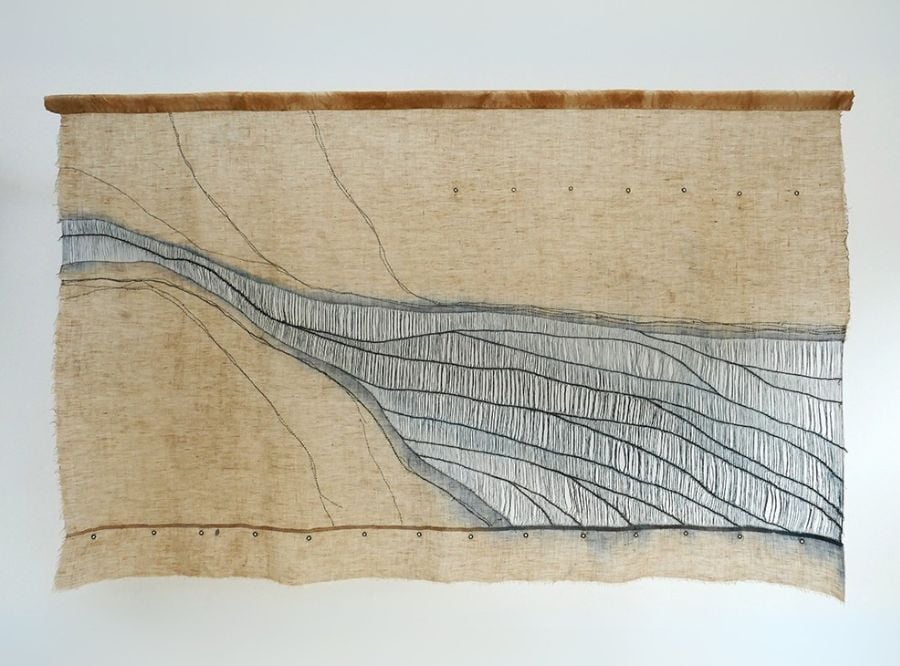
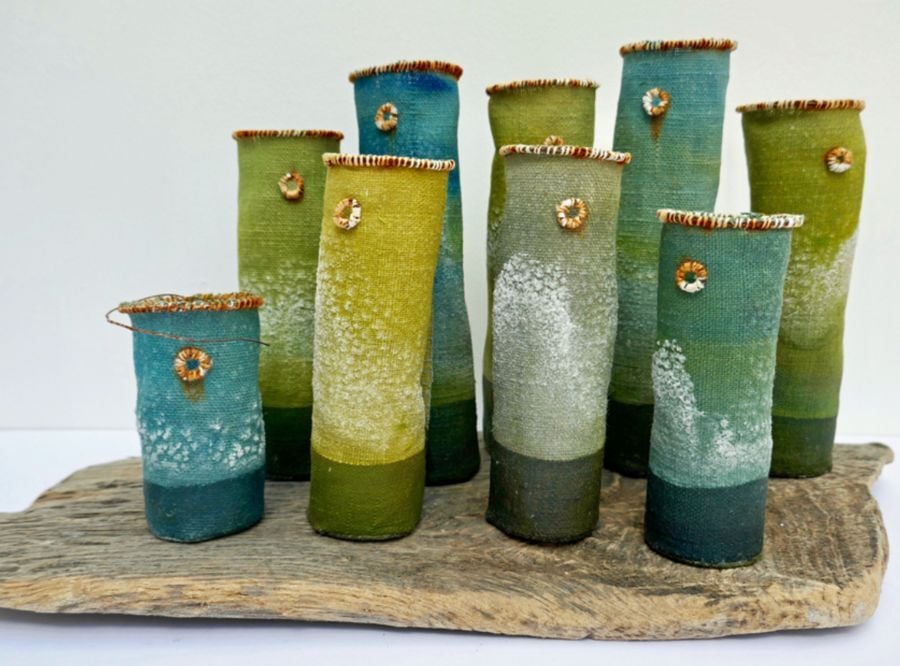
In Sensing Place, Debbie Lyddon shares her method: begin with a sense walk – her daily practice – then turn the sounds you draw into stitch, mark, and form. They become a soundscape, a graphic score, or what Debbie calls a ‘soundmark.’
You'll discover how to use sight, sound and touch as tools to explore, experiment, and push your boundaries – the same way Debbie does in her own studio.
How do you draw a bird call, or write down an engine's rhythm? In this course, you'll learn Debbie's sensory-led approach to making.
Sensing Place turns your senses into 2D and 3D artworks
Sensing Place hands you a translation you've never had before: turning sound into stitch, mark, and form. You already know how to work from what you see, and what you touch. This adds the one sense no course on the platform teaches you to use. There's no established way to draw a bird call or write down an engine's rhythm.
Sight
sketch and collage
Sound
soundmark to stitch
Touch
weather and shape cloth
Your work
2D and 3D, one language
Use sight, sound, and touch as creative prompts to make visual art.
Translate sketches and observations into expressive 2D and 3D mixed fibre artworks.
Experiment with unconventional materials, mark-making, stitching, and collage.
Develop a confident, intuitive practice grounded in experimentation.
Learn playful, process-led approaches to move beyond habit and expectation.
Explore weathering, dyeing, and deconstructing cloth, to stitch into 3D forms.
Enrolment closes 5 October Places are limited
Previous student work from Lyddon’s course
I was feeling a bit stuck before taking Debbie Lyddon’s Sensing Place course. I needed to be around other artists who were pushing the limits of the fiber material techniques and ideas to see the possibilities.
I’ve been a painter in acrylic and mixed media for over 40 years and have an established studio and practice, but have only just begun exploring stitching and fabric. I've loved Debbie's work since seeing it online, and she has given me so many new tools and methods to work with. My walks have turned into much richer experiences, expanding my eyes and ears and broadening my sketching practice.
This course has really captivated me. So many techniques, tips and insights into Debbie’s work but it’s also so open for each individual's creativity to shine through. I don't want to be a copy – I want to be inspired to take ideas and run with them and this course has done that in spades.
I don't live by the coast but have a caravan in mid Wales near Barmouth, so next time I'm there I will spend some time looking, listening and exploring textures. The other day I listened to the aircraft going in to land at Birmingham airport, and I'm already thinking about how I could represent the sound.
During the pandemic, I was away from a true studio space, so began working digitally almost exclusively – doing a lot of drawing and surface pattern design. This course has helped me to get back to working with real materials and find my voice again.
My art practice was going well before this course but Debbie's insight and techniques have put the icing on the cake of my art. IT’s been life-changing, in a deep, think-outside-the-box way! Debbie gave us everything she does from her sketches to descriptive words, inspirational quotes and reads, inspirations from her environment, passions, preferred products, techniques and display ideas and more.
Debbie Lyddon has been a full-time textile artist for 15+ years. She works from her Norfolk coast studio, where she fuses sight, sound, and touch into 2D and 3D mixed media art that’s deeply personal.
Long before she found art, Debbie says music and sounds shaped her artistic pursuits. In Sensing Place she shares her method for listening more closely, and using those observations as the foundation for your creativity.
She teaches the same way she makes – curiosity first, technique second – and in a way you've never seen or heard before.
My art is a conversation with the sensory experiences of my environment – the call of the seabirds, the rhythm of the waves, and the tactile joy of natural textures under my hands.
My practice is an exploration of sight, sound, and touch, inviting a dialogue between the artist and the landscape.
- DEBBIE LYDDON
The course is fantastic! Debbie is a wonderful teacher – intelligent, knowledgeable, very down to earth and approachable. The content is huge and wide ranging. It has opened my eyes to a whole new world of possibilities and helped me to access the creative, almost childlike side of my brain.
I very much enjoyed Debbie's teaching. Her welcoming presentation of process and technique takes down your unseen barriers and extends permission to explore and dive deep into uncharted territory.
My first online art learning experience exceeded expectations. Debbie was encouraging and constructively critical in the Facebook group feedback, which made the whole process feel genuinely student focused. It’s really pushed me to explore new processes and grow in confidence.
It's the best workshop I've ever had. So rich with information, practical and theoretical. Debby creates a warm, welcoming and relaxed atmosphere which makes me feel free to experiment and just try out things. She makes it easy to join and have fun.
I really enjoyed Debbie's approach to teaching. I love how she talks with her hands – so very expressive and engaging. This course has opened my eyes to a new way of looking at my surroundings and using all my senses and I now have new skills and processes to carry forward into my own practice.
The course did not disappoint! Debbie Lyddon is super talented, highly accomplished as an artist and tutor but her teaching style is so warm and encouraging. She just makes you want to get your sleeves rolled up and get stuck in.
-
Module one: Sight – moments of being
Slow down on a sight walk with Debbie, and notice how much of your surroundings you've been walking straight past.
In this module, you'll:
- Create a hand-stitched paper sketchbook and portable drawing kit to document your observations.
- Draw and write in wet media, exploring watercolour and ink techniques on large sheets of paper.
- Bind your sight walk discoveries into a caterpillar book, using Debbie's "Moments of Being" concept to choose what stays.
- Create a hand-stitched paper sketchbook and portable drawing kit to document your observations.
-
Module two: Sight – moments of being two
What happens when you cut up your own drawings and put them back together differently?
Along the way, you'll:
- Mix a full palette from just three primary colours, in the tradition of painter Terry Frost.
- Create textured paste papers using Debbie's own paste paper recipe.
- Cut, arrange and hand-stitch your shapes into finished collage compositions.
-
Module three: Sound – decorating the silence
There's no established way to draw a blackbird's call or a dripping tap – so you'll invent your own visual language for sound. end of this module, you’ll have made your own first batch of soya paint.
You'll explore how to:- Go on a sound walk, listening closely before drawing what you hear.
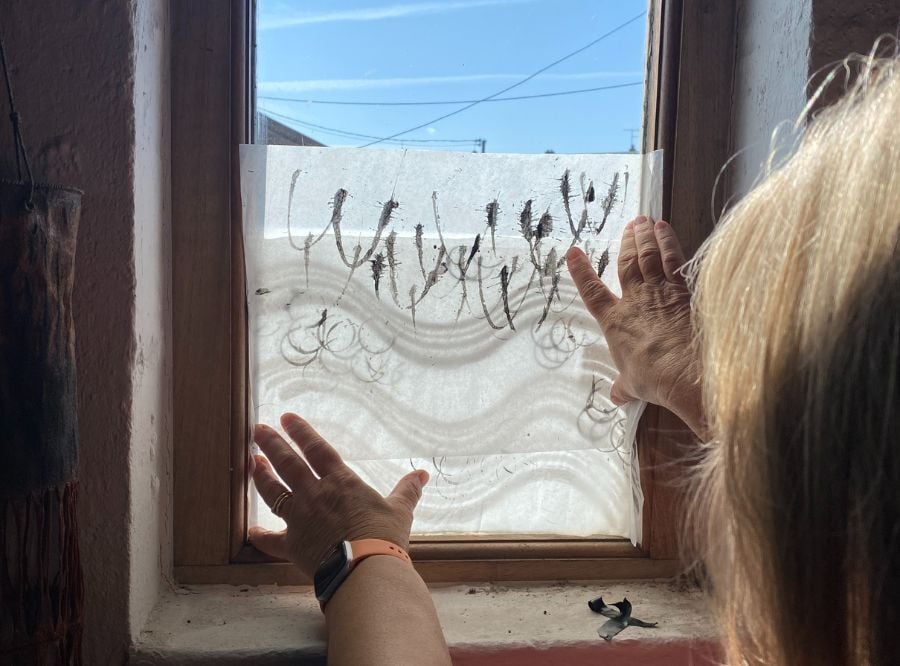
- Layer tissue paper and Indian ink into your first soundscape.
- Translate your soundmarks into stitch, using thread, wire and a coat hanger to build texture and rhythm.
-
Module four: Sound – decorating the silence two
Sculptor Barbara Hepworth believed a hole could hold as much meaning as solid form – you'll test that idea in cloth.
Through this module, you'll:
- Explore Barbara Hepworth's approach to holes as a way of seeing sculptural space.
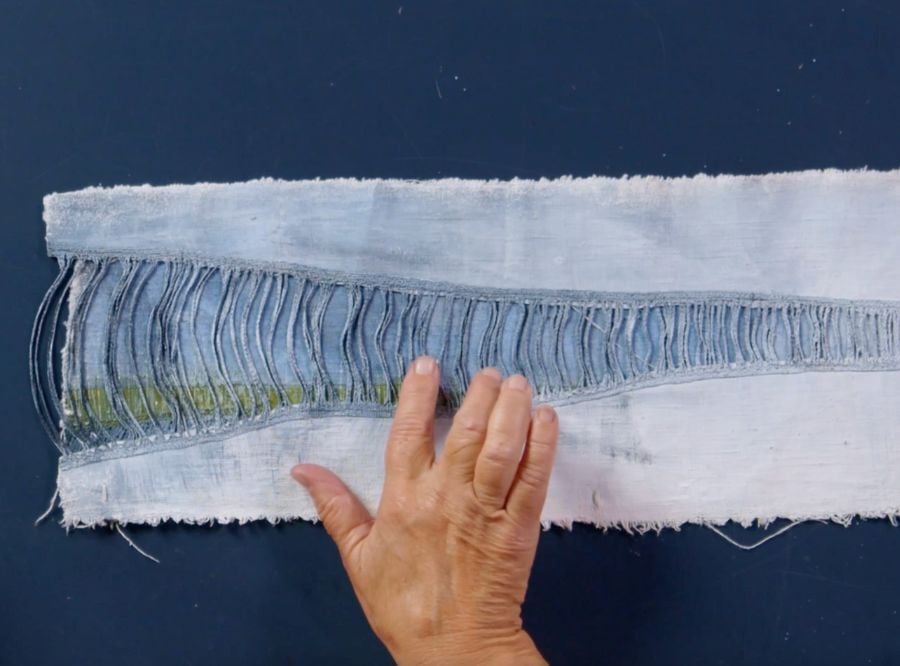
- Make holes in cloth using slitting, cutting, punching and eyelets.
- Build a long soundscape cloth that combines stitch, paint and hole-making.
-
Module five: Touch – holding place
Head outdoors for a touch walk – collecting objects and noticing how wind, water and light leave their own marks on cloth.
Working with what you've collected, you'll:- Consider what each one tells you about where you found it.
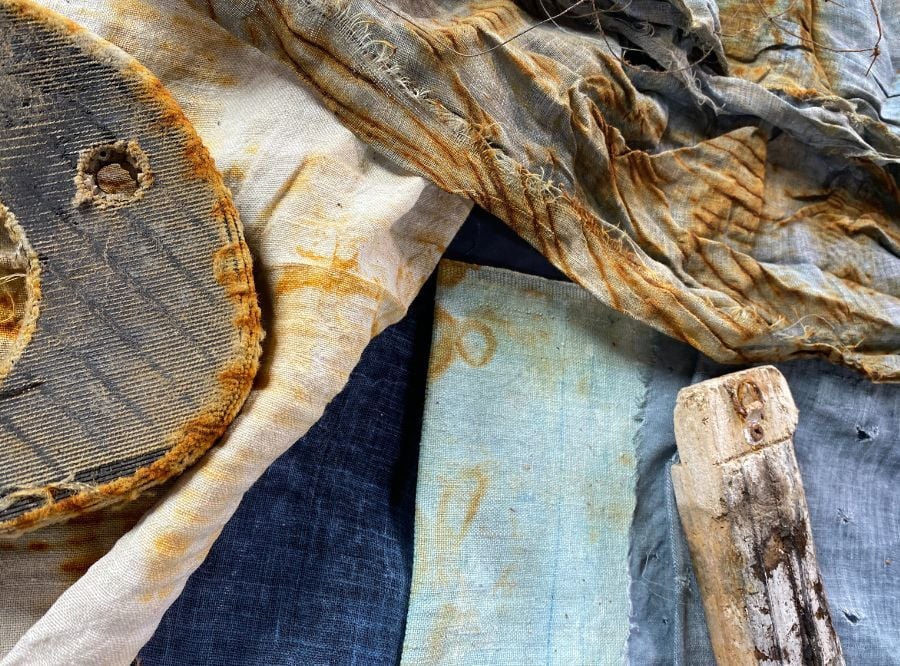
- Weather cloth naturally, using techniques for seeping, staining, dripping and fading.
- Stitch a soft bag or container from your own weathered cloth, to hold your collection.
-
Module six: Touch – holding place two
What happens when paint, PVA and wax stop being coatings, and start being structure instead?
Across this module, you'll:
- Stiffen cloth with paint, PVA, wax and starch to give it its own rigid form.
- Shape tubes, coils and circles inspired by the objects you've collected.
- Form a simple 3D container from your stiffened, textured cloth.
-
Module seven: Action to form
Artist Richard Serra made a list of verbs – to wrap, to weave, to bind, to cut – and used them to build sculpture. Here, you'll put the same actions to work, moving from flat paper to 3D form.
Through hands-on making, you'll:
- Work through a paper manipulation exercise, taking a flat sheet into 3D form.
- Make a paper pattern from your favourite shape and cut it from stiffened cloth.
- Join and manipulate your pieces into a finished cloth sculpture.
-
Module eight: Waxed cloth collage
Revisit everything you learned in Module two, about making paper collage, and remake it in cloth, wax and stitch.
Building on module two, you'll:
- Prepare a gessoed cloth background, then paint, cut and stitch fabric pieces onto it.
- Wax your collage and embellish it with sgraffito and shoe polish.
- Finish with hand or machine stitch to add a final layer of texture.
-
Module nine: Combining the senses
You've explored sight, sound and touch on their own. Now bring all three together into one body of work.
In this closing module, you'll:
- Go on a final sense walk, gathering together sight, sound and touch observations.
- Explore oral visuality and haptic visuality – seeing sound and touch as one connected language.
- Make a sensory book or object that draws on techniques from across the whole course.
Join Debbie in the student community for personal feedback and direction, 18 September–13 November.
You’ll be supported every step of the way with:
Direct interaction with Debbie for up to 8 weeks.
15 + hours of professionally filmed lessons showing real details, not just the steps.
Lifetime access for unlimited learning
Worldwide community of artists.
Your questions answered via two live Q&As.
Comprehensive workbooks to reinforce your learning.
… plus return to the community and resources time and time again to extend your learning.
Sensing Place
Lifetime access to all course materials
Learn a new medium and techniques directly from Debbie
Only available once per year
Enrolment closes 5 October | Places are limited
Our promise of excellence
We take great pride in our commitment to excellence. Our productions are professionally crafted to the highest standards, and our professional tutors share decades of knowledge with generosity and care.
To protect their IP and your investment, our money-back guarantee offers a full refund if you’ve watched less than 10% of the course within seven days and are not satisfied. See our terms for details.
Our friendly team is here to support you before, during and after your course. Reach out anytime at support@taketwoartcoures.com – we’re always happy to help.
Sensing Place is perfect for those looking to…
- Explore how to turn sound into visual art.
- Finish with 2D and 3D mixed media artworks, not just a sketchbook full of ideas.
- Learn techniques to turn sensory stimuli into stitch, mark, and form that reflects where you live – coastal, cities, suburbs, or inland town landscapes.
- Learn a tutor’s method, not just see her finished pieces.
Sensing Place is probably not right if you’re…
- Not interested in working with sound as part of your practice.
- Looking for a style to copy, not a method to build from
Have another question? We’re here to help! Please contact the Take Two team at support@taketwoart.com
Course-specific FAQs
-
I've already taken courses using walking and place before. How is this course different?
If you've taken other courses around "being inspired by place", this course provides something more specific: three separate, approachable ways of translating inspiration and sensory experiences into mark and form. There’s a named technique for sight, a different one for sound, and a third for touch.
-
Will my work just end up looking like Debbie's?
-
Do I need to live somewhere coastal for a course like this to work for me?
Debbie's practice is built around her coastal Norfolk home, but the method she teaches – translating what you see, hear, and touch into mark and form – works with whatever landscape surrounds you. Several students have created work from cities, suburbs, and inland town landscapes.
-
How does this course take my work from 2D to 3D?
The course deliberately moves you toward 3D work, if that’s your interest. The sight and sound modules produce 2D collage and stitched work, and the touch modules move you into 3D cloth vessels and forms. By Module 7, you're translating flat sketches directly into sculptural pieces.
-
How is sound used in art making, if I've never worked that way before?
No musical background or special training is needed for the course. Debbie's own training as a musician shaped her method, but what she teaches is a listening and translating technique that turns sounds into a soundscape, graphic score, or "soundmark”.
-
Is this just a waxed cloth collage course?
No, waxed cloth collage is one module (Module 8) inside a nine-module course that also covers sketching, soundscapes, stitched mark-making, cloth weathering and 3D cloth sculpture. It's a technique you'll learn, not the whole course.
-
I already have a fibre/textile practice – is this too basic for me?
This course is perfect for practicing fibre artists interested in exploring their relationship to place in their work or taking their work from from 2D to 3D.
Several of our students have exhibited or had their own studios before taking this course:
I’ve trained in constructed textiles, taught in secondary schools and exhibited internationally. Debbie’s briefs challenge and push me to try new processes. It’s an injection of energy, passion, enthusiasm and encouragement, and a tool kit to feed your inner being. – Tessa J.
Before the course, my textile practice was focused on stitching, cyanotype, and working with familiar materials, often guided by technique rather than observation. Since enrolling, I’ve explored new ways of engaging with fabric and stitch, and intuitive mark-making. I feel more set free from output-making, more connected to simply trying things and seeing where they lead. The course encouraged me to find a different way to interpret my local landscape and use that as inspiration in my work, making the process as important as the outcome. – Sarah L.
Course Logistics FAQs
-
How much does it cost to enrol?
Enrolment in Sensing Place is:
AUD $579
USD $429
GBP £319
EUR €369
NZD $709
CAD $589
Payment plans of 2 or 5 months are available at checkout – no need to email us, just select your preferred option when you enrol.
A note on value: this is a course students describe going back to again and again. Lauren said she finds herself returning to the modules "over and over" and that lifetime access "is not a bonus – it is a necessity." You're not paying for eight weeks. You're paying for a resource that will keep working for you for years. -
What materials and supplies are required for this course?
A guideline of materials required can be downloaded here. A complete list will be provided to enrolled students.
We encourage you to use what you already have first – you don't need to buy everything at once.
If the combined cost of course and materials is a concern, the payment plan option at checkout may help spread the overall investment. Any specific questions before you enrol? Reach us at support@taketwoart.com.
-
When does enrolment close?
Enrolment closes on 5 October 2026.
-
Do I have to watch the videos at a set time or follow a schedule?
There is no fixed schedule, no live sessions you have to show up for. But there are two live Q&A sessions during your tutor’s live interaction period – on 8 October, 6am AEST and 29 October, 6am AEST – both of which will be available for replay. The course was built for people with full lives – you watch when you want, pause when you need to, and return to a module three times if that's what it takes.
As Wendy put it: The freedom to take your time and disappear down your own rabbit hole is such a joy. -
How does interacting with your tutor actually work?
Between 18 September - 13 November, Debbie is available in the private student community group on Facebook. This isn't a cursory presence – students consistently describe her feedback as detailed, personal, and genuinely engaged with their individual work.
There are also two live Q&A sessions where you can submit questions in advance:
- Live Q&A #1: 8 October 2026
- Live Q&A #2: 29 October 2026
These are streamed via YouTube and later uploaded into the course portal so you can watch even if you can't join live.
After 13 November, your tutor steps back from the group – but the community stays open, and you have all the course content for life. -
Do you offer closed captions?
Yes we do. We offer closed captions in English, Spanish, German and French.
-
I’m not very tech-savvy. Will I be able to manage an online course?
Yes. Our students regularly report – with visible relief – how straightforward the platform is to use. If you can watch a video on your phone or computer, you can do this.
And if anything doesn't work as expected, we're easy to reach. We're well known for our customer support – just email support@taketwoart.com and a real person will help you -
What currencies do you accept?
We've set up geolocation to display your local currency where possible and currently accept AUD, USD, GBP, EUR, CAD and NZD. If yours isn't listed, your bank will convert the charge automatically – you won't be blocked from enrolling
-
Can I take this course on my phone or tablet?
Absolutely. The course is fully responsive and works across laptop, tablet, and phone. Switch between devices freely – all you need is an internet connection.
-
What if I need support during my course?
Post in the student community group and someone will respond – whether that's your tutor during the live interaction period, a Take Two team member, or a fellow student. The group is active and genuinely supportive.
For technical questions, or if you'd prefer not to use the Facebook group, email support@taketwoart.com directly.
-
Can I gift this course to someone?
Yes – and it's a beautiful gift. Email us at support@taketwoart.com with the details and we'll create a personalised digital voucher for you.
A note from Debbie
I don't think in colours, or even lines – I think in rhythms. All the work I make has a rhythm running through it, and those rhythms come from sound moving through time.
I'll put bar lines, straight from musical notation, into pieces about a landscape that has nothing to do with music – because a horizontal landscape cut through with verticals, moves the same way a piece of music does.
You'll be amazed what opening your ears does to your art practice.
- DEBBIE LYDDON
Ready to listen to your surroundings?
Sensing Place is a 3D mixed media art course taught by Debbie Lyddon, centred around sight, sound and touch.
It’s one of several process-led courses available at Take Two taught by working artists in their field.
Enrolment closes 5 October Places are limited

© 2026 TAKE TWO ART. ALL RIGHTS RESERVED.
We acknowledge the traditional custodians of country throughout Australia and their continuing connection to land, sea and community.
We pay our respects to them and their cultures and to their elders both past and present and extend that respect to all Aboriginal and Torres Strait Islander peoples today.