.jpg)
Early life
Judy grew up in an isolated area on a rural encampment, “My dad had cattle when I was a little child and he just had this great big empty space, and there was an elm tree that my mother would look out at from her window. We had a horse, and we had these white fences, so that's where I grew up.
The emptiness and isolation that I had as a little girl are important, and my father was from Finland. He came over when he was five, and the Finnish aesthetic, I think, is really very pure, noble, and simple. That is the aesthetic of the Finnish people within me. Those two things are important to who I am today.”
.jpg?width=750&height=750&name=Judith%20E.%20Martin%20(2).jpg)
Aesthetics
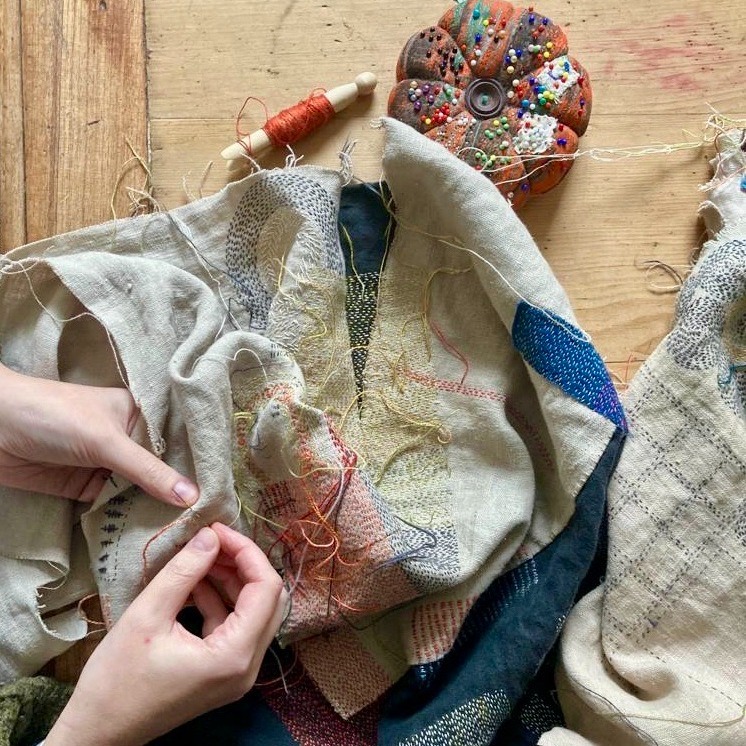
Judy takes aesthetics in her work very seriously, “I just lately started talking about the ‘aesthetic of care’ in my work,” she says. “I was talking about the aesthetic of labour because there's a lot of stitching, a lot of labour and aesthetic touch, aesthetic of simplicity. But now, in this terrible world we're navigating through, I just have this idea that maybe I can make something that shows care.”
The aesthetics of care are rooted so deeply in Judy’s work that they even come down to the materials themselves. “A lot of the fabrics I use are gifts to me from women,” Judy says. “They're from their matriarchal side; their mothers or their mothers-in-law had collected these linens, table linens or hand-worked lace, tablecloths and doilies. I think for sure that by giving them to me, they're hoping that I will take care of them. I don't go to the fabric store to buy quilt cloth very often, usually I use tablecloths and old blankets. People mail me blankets. I repurposed linens and blankets, and whatever people give me, sometimes they give me old towels. Sometimes there's stains in these pieces, and there's holes and rips and stuff and I think that's all okay because then I try to clean them or I use them the way they are. I mend the holes. It's all part of it.”
.jpg?width=750&height=500&name=Judith%20E.%20Martin%20(1).jpg)
Advice
Judy’s sage advice for aspiring artists setting out on long-term projects is this… “You just have to trust yourself and accept that is not always going to be right. When you run into something that is making you uncomfortable, just stop for a while and put it away in a drawer, let it steep for a while and work on something else because you're not ready yet to work on that piece.
Most of my quilts do take years to make because I'll work on them, and then I won't know what to do next, so I'll put it away, and my life will continue, and I'll learn some new things, and somebody will say something, and somebody will give me some cloth, and I'll know what to do then so I take it out again and work.
I work on maybe four or five pieces at the same time. It's like our life: we make dinner, we tell the kids to catch the bus, we get ourselves out to work, we buy the groceries, we drive long distances to see our kids or whatever we do. We do it all. But we don't just do one thing; we have to do all kinds of things. I think realising that tomorrow is another day, you'll be able to figure it out tomorrow.”
About Judith E. Martin
Judith E. Martin (Judy) grew up on a large rural property in the Fort Frances area of Canada. She married Ned Martin when she was 22, and the couple raised their four children in three beautiful northern Ontario locations: Thunder Bay, Kenora, and Manitoulin Island. Judy and her husband live and work on Manitoulin Island, Lake Huron, Ontario, Canada.
Judy made her first quilt at the age of 20 and soon became inspired by the quilt’s connection to the important life passages that occur in bed. During the 90s, she made hand-stitched story quilts using the poetic code she discovered in traditional quilt patterns and world embroidery. She holds two BA degrees in fine art (1993 Lakehead University [Thunder Bay, ON] and 2012 Middlesex University [London, UK]). Currently, her most important work is about touch and vulnerability and about the relentless passage of time.
Judy’s work has been widely exhibited across Canada as well as the USA, Europe, and Asia. Her stitched artwork was featured in the book Slow Stitch: mindful and contemplative textile art by Claire Wellesley Smith (2015) and is supported by the Ontario Arts Council.