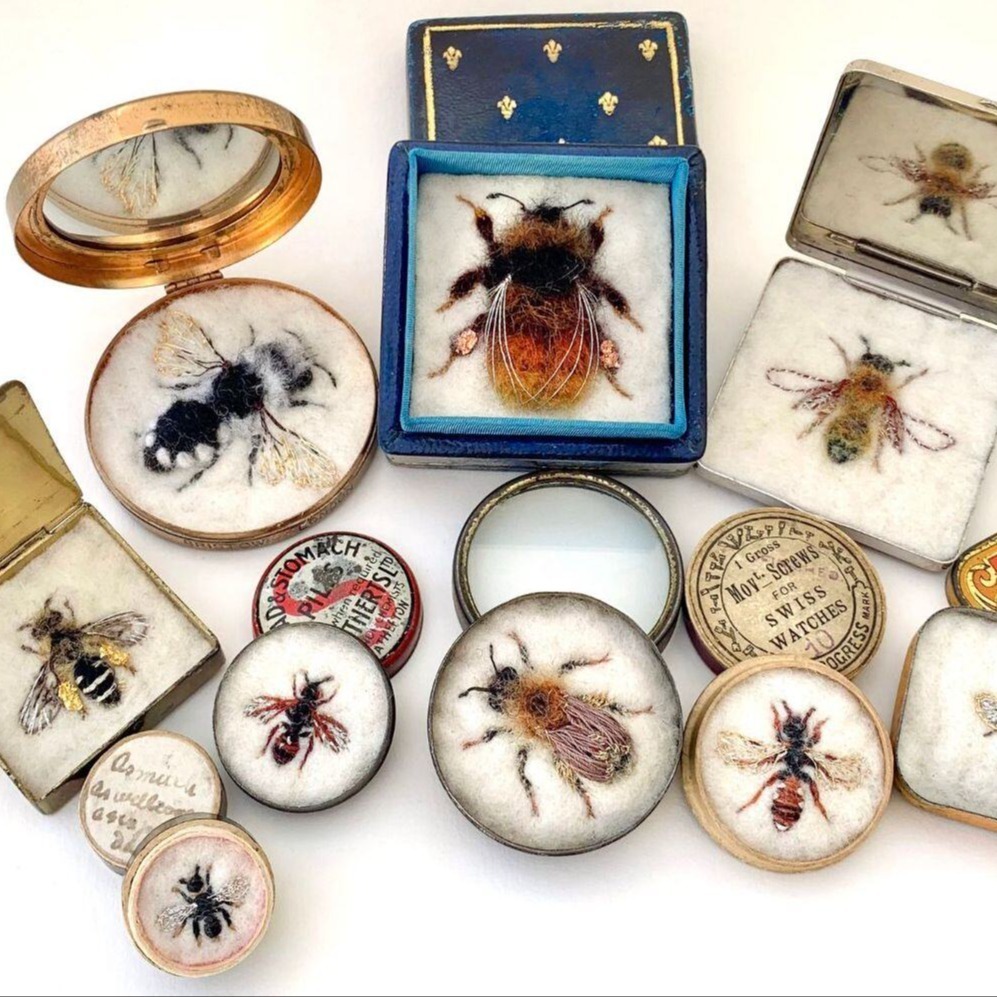
In 2017, Lydia instigated a collaborative project, called FIFTY BEES; The Interconnectedness of All Things and has created hundreds of bees since then, each one housed in its own container and made using vintage materials. They are unique, hairy, feature intricate details and use fine metallic threads. The past meets the present in a small way, and is presented next to its companion artwork and exhibition form, offering insights into the bee population, and highlighting how these important pollinators and humankind are wholly interlinked with the ecosystem.
Lydia's practice is about making and unmaking, undoing and unconsuming, as she negotiates her way around being an anti-consumerism artist. Lydia continues to work on her sustainable art practice, and is interested in what we need to say yes to and what we need to say no to. Her work with bees may be small, but the conversation about changing our habits has viewers buzzing with ideas about caring for things we don't often know are there.
Early beginnings as a maker
“I think everybody is born a maker,” says Lydia. “We make, from the day we start playing with our food, and our Play-Doh. I've always been a maker and I've been lucky that it's never been something that I've lost. I've never found it, shall we say, ‘ground out of me’. I've always had a place to do it. I have a conversation with a lot of people about being creative and say to them, ‘You just haven’t found your thing yet.’”
Lydia’s early career aspirations were to be an artist or a zookeeper. “We grew up in a home where there were always art materials and the art materials were cast-offs, you know, so there was always card and yoghurt pots and pencils and stuff. But there was also a TV programme called Animal Magic, which had a guy called Johnny Morris on it. And I thought, that's what I'm gonna do. I loved animals. I loved art, and it was either zookeeper or artist.”
Lydia’s creative path was influenced by her artist mother. “She was always very encouraging of our creativity, in no forceful way. In terms of creativity, she was the primary source and she never said to me, ‘Don’t do that’. In terms of the environment, it was always there. I was 14 when I first joined Friends of the Earth.”
.jpg?width=800&height=513&name=Lydia%20Needle%20(4).jpg)
Art eco activist
“I find that I’m always playing around with how I’m introducing myself. Art Eco Activist is where I have settled at the moment. Activism is about gently encouraging people into the conversation about the environment—that’s what that means to me. I'm trying to activate people to engage in the conversation and maybe make small changes in their lives through my art.”
“Through the FIFTY BEES project, a lot of the gentle suggestions are just about changing simple things in your garden. So in Britain, we have ‘No Mow May’; the idea that you allow your lawn to grow. Because at the moment, despite the rain that we've got, which is just relentless, there are pollinators out there, and they need food, because the reason why the pollinators are in such a dire situation is that there isn't food for them. So we in our gardens, just by not mowing our lawns can provide valuable resources for nature.”
Lydia works for an art charity as her day job to support her art practice. “There’s an awful lot of nourishment that comes from it, from working with artists and people coming to workshops. It’s very mutually supportive and I have met some amazing people. The admin part of my job is so different from my creative practice that it gives my creative brain a bit of a rest. It can be good to have contrast.”
.jpg?width=800&height=422&name=Lydia%20Needle%20(2).jpg)
Needle by name and nature
Lydia does creative work with needles and it’s her family name. “I heard someone say the most important invention of humankind was the sewing needle. It’s a good name!”
The artist came to felt and needlework after a bout of mental ill-health. “I’d been running a textiles department with as many reclaimed textiles as possible but I hadn’t found what suited me. My friend took me to a workshop and I realised it was exactly what I had been looking for. Wool is such a wonderful material to work with and it’s got good environmental credentials, and my hands loved it instantly. I describe it as coming home.”
Soon after that, Lydia left teaching. “Part of ‘mending’ myself was needle felting. Then I ended up making kits for bunnies and dogs, all sorts. That’s what I was doing before the bees.”
Bringing the bees
In 2016, Lydia read an article about Britain’s endangered bee species. She was surprised to learn how many bee species there are in Britain. “I thought, ‘If I don't know and I am interested in nature, what about other people?’ and if you don’t know about it, you can't advocate for it.”
This inspired the FIFTY BEES projects, chosen in honour of Lydia’s 50th birthday. She then progressed to include another 50 art pieces, involving 50 other people. These additional works are in response to the bee’s ecology. “We didn’t just want more pictures of bees!” she adds.
This evolved to become an exhibition, with Lydia’s friends as well as other contributing artists. It has since expanded to include 250 individual bee works, each made from wool and old threads. Some include additional highlights like antique gold leaf; to denote how precious bees are.
Lydia is now an expert ‘maker of bees’, creating incredibly life-like pieces, but her vision for her work doesn’t always match the reality. “You have to be kind to yourself as a maker and artist and say, “I can only do what my hands want to do. I might fantasise about the bees being perfect but they’re not. They’re made of needle felt and they’re made by me. I have had experts tell me they look like the real thing but there is definite poetic licence.”
Each bee lives in its own tin/container, items found in stores and antique shops. They range from powder compact containers to rouge pots to jewellery boxes, antique lockets and containers for watch parts.
.jpg?width=662&height=442&name=Lydia%20Needle%20(3).jpg)