Tansy Hargan: It’s About Colour
UK artist Tansy Hargan talks to Take Two about how she listens with her eyes and observes everything she sees.
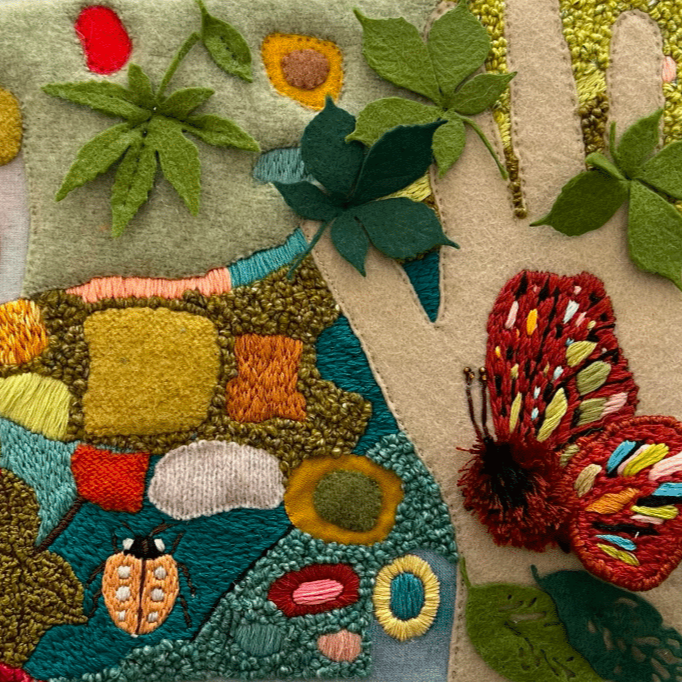
Art is an extraordinary medium that can educate and enlighten society on challenging and sensitive issues, such as racism and mental health, by skillfully portraying emotions, experiences and narratives.
Through their artistic creations, artists can captivate and profoundly impact their audience. Sharing these profound messages requires courage, vulnerability, and the willingness to expose innermost thoughts and experiences. These brave artists act as a catalyst for change, pushing the boundaries of societal norms and initiating vital conversations. In doing so, they provide a safe space for healing for themselves and those who engage in their work.
Sabine Kaner is a remarkable artist renowned for her intricate and emotionally charged textile art. Born in Germany as a biracial person, she developed a passion for stitching and textiles from a young age, which will drive her artistic journey. Having studied printmaking in London and Manchester in the 1980s, Sabine’s art is a beautiful fusion of embroidery and fine art, where she masterfully combines stitch, print, collage, and, most recently, glass to create captivating pieces. Take Two loved hearing about Sabine’s artistic journey and cultural experiences.
Sabine always had a passion for art. “I’ve thought of myself as an artist from a very, very young age,” she says, “I knew I wanted to go into art when I won my first competition at the age of five, and from then on, I think I felt drawn towards making things and drawing.”
Once she was older, Sabine pursued her art more seriously, “When I was about 17,” she says, “I went to St. Martin’s in London. Then, later on, I went to study in Manchester, which was the start of my formal artistic training. I did painting and sculpture and all that, to start with, and then I specialised in printmaking. But, I always found that printmaking felt very flat to me. Something was missing, and I started using bits of fabric in my prints. I used to get into terrible trouble because they didn’t like me using anything that was raised in the etching presses. So I started doing a bit of printing and introduced a bit of fabric into the screen printing.”
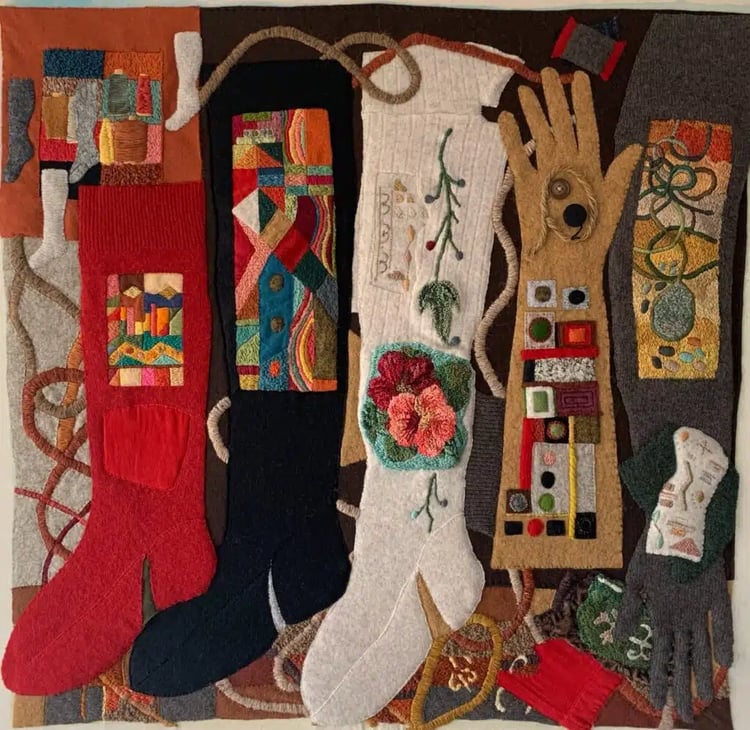
In time, Sabine moved to stitch due to circumstances well beyond her control. “My daughter was born with a disability,” says Sabine, “and I spent a lot of time in hospitals and places like that, so taking stitching with me was so much easier than taking paints or pencils and things, and often I had to be relatively quiet so that I would take a bit of embroidery, and I would sit and start stitching. It really helped me deal with things emotionally. “
Sabine’s process is one of evolution, “I start with an idea,” she says, “and as I’m working through the piece of work, the idea often evolves and takes me into different directions and thought processes. It’s like I’m having a conversation with my work. I’m having a conversation with the needle and thread, and I’m conversing with it as I go along, and sometimes, it takes me in different directions that I hadn’t planned. You can only plan so much, and then the piece evolves. It’s quite funny because sometimes it turns up exactly as I had the image in my head, but then, that’s the way it was meant to be.”
Sabine finds inspiration as she goes, “Composition and layout are quite important to me,” she says, “and I work out where I possibly want things to go, and then I collect the bits of fabrics, and I find that I get very inspired by the colours of threads and pieces of fabrics. They often determine further along the line which way the piece of work is going to go.”
“I’m also very inspired by the textures of boiled wool; I love it,” she says, “Textures direct my pieces quite often. So then I start a bit of stitching and a bit of embroidery, just all the time looking at how the piece is progressing. Because once you start stitching and placing a piece, sometimes the next bit doesn’t quite work with that bit, so you alter it. But the nice thing about textiles is you can change it as you go along, so nothing is ever wasted, and a mistake isn’t really a mistake.”
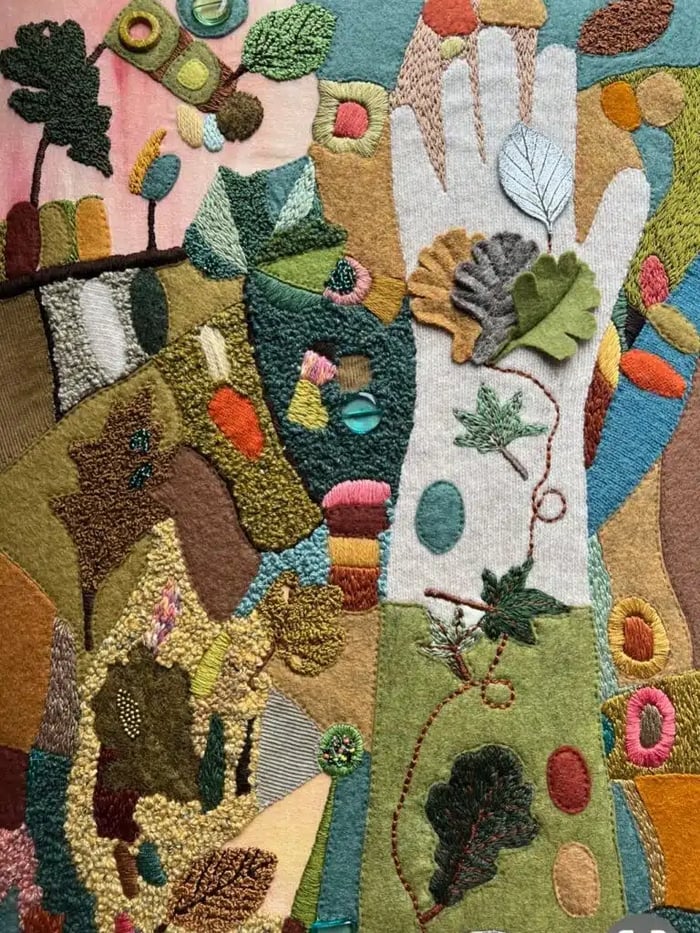
Sabine’s piece, When the Boat Comes in, is based on struggles her father recently went through as a Jamaican immigrant to the UK, “It started really with the Windrush scandal, really in about 2018,” Sabine says, “When people who were from that generation were being told that they had to leave the country, that they weren’t British anymore because they couldn’t produce the right paperwork. So I was really upset about all of that.”
Sabine was no stranger to the difficulties of living in the UK with Jamaican heritage, “As I grew up with a Jamaican passport,” she says, “I had experienced quite a lot of this sort of thing myself. And every time I returned to the UK, they said to me, you can only stay here for three months. Ultimately, it got so bad that my mother-in-law, when I was in my 40s, employed an immigration solicitor, and then I became British. But I was really sad about that, that I’d have to lose my identity. So I did feel very strongly about what was going on in the UK, with the politics, and so I made a piece in reference to that. Then it snowballed into eventually realising that my father was actually on that very first boat in 1948. He originally came to the UK in the RAF and then went back to Jamaica and things were not great economically so many of them were suddenly invited to come to the UK to rebuild Britain. A lot of them took up that call, having been here before. I suppose they felt this sort of familiarity, and my father was very much part of that kind of British Empire thing. He was born in the 20s, and everything in school was taught about being British. In fact, he was probably almost more British than the British. That’s how it worked. Coming to the UK seemed quite normal to him, really. So he returned, but it wasn’t quite as he had hoped. And it was very, very harsh times, very difficult.”
Sabine has seen positive growth through her time as an artist, “I found it nice that people have talked to me about their experiences of immigration,” she says, “I’ve spoken to quite a few husbands who talked to me about how they were very prejudiced when black people arrived in the UK, and how much they’ve learned and they resonated with the pieces that I had made. I think conversations like that have been really, really good.”
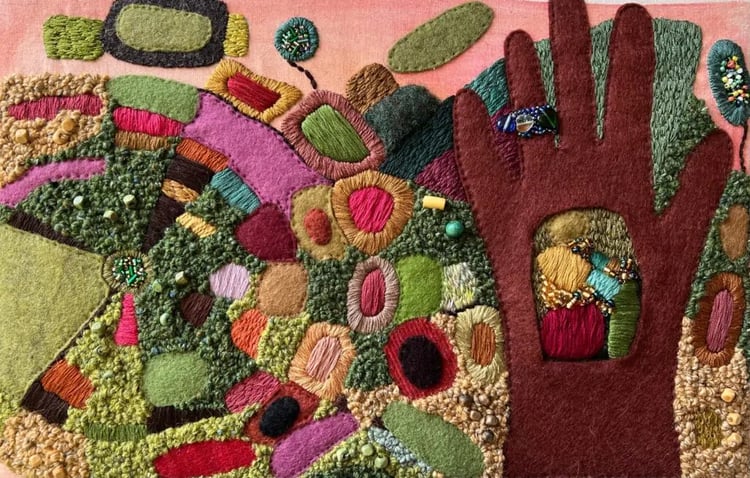
Sabine Kaner attended art school in the 1980s in London and Manchester and studied printmaking. She then spent some time working in an unrelated field, had a family and started her own small Arts and Crafts business.
Sabine later studied social sciences and art therapy as a mature student at the postgraduate level. Family and life circumstances prevented her from continuing to develop her practice until only a few years ago. She now works with mixed media and draws upon many disciplines to produce her work.
Her experiences and studies very much inform Sabine’s work. Her identity as a biracial person is intertwined with the work she produces. Compositions often express a very complicated personal journey.
Sabine has a strong interest in Mental Health and Outsider Art, specifically in the perspectives of marginalised people and artists.
She has also worked on various community projects, including an artist’s residency in a school focusing on developing early creativity.
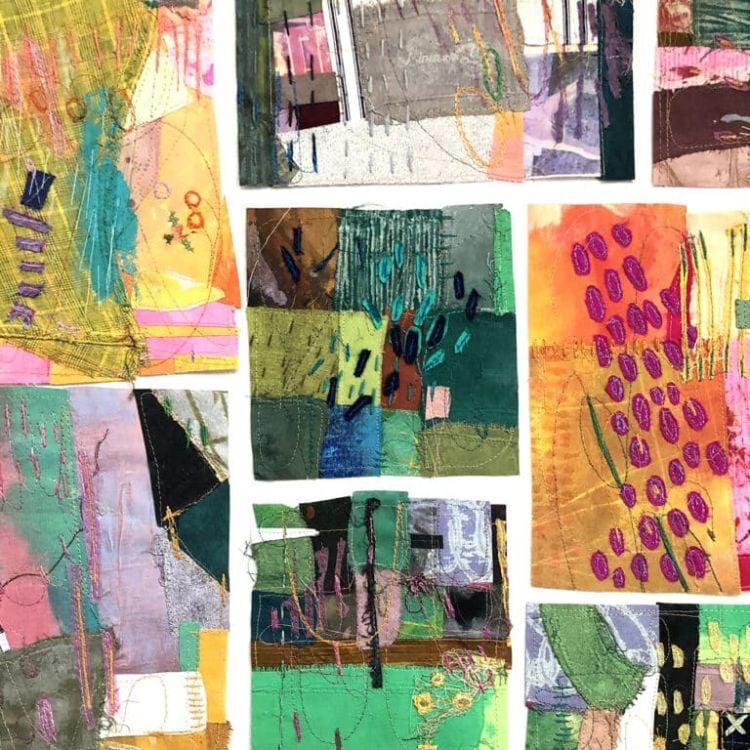
UK artist Tansy Hargan talks to Take Two about how she listens with her eyes and observes everything she sees.
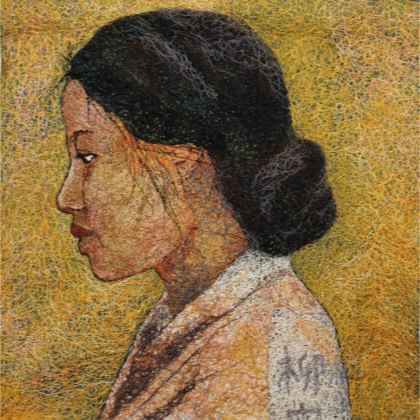
Artist Shin-hee Chin is influenced by feminist traditions, Christian spirituality, and Eastern philosophy. She shares her unique take on life, art...
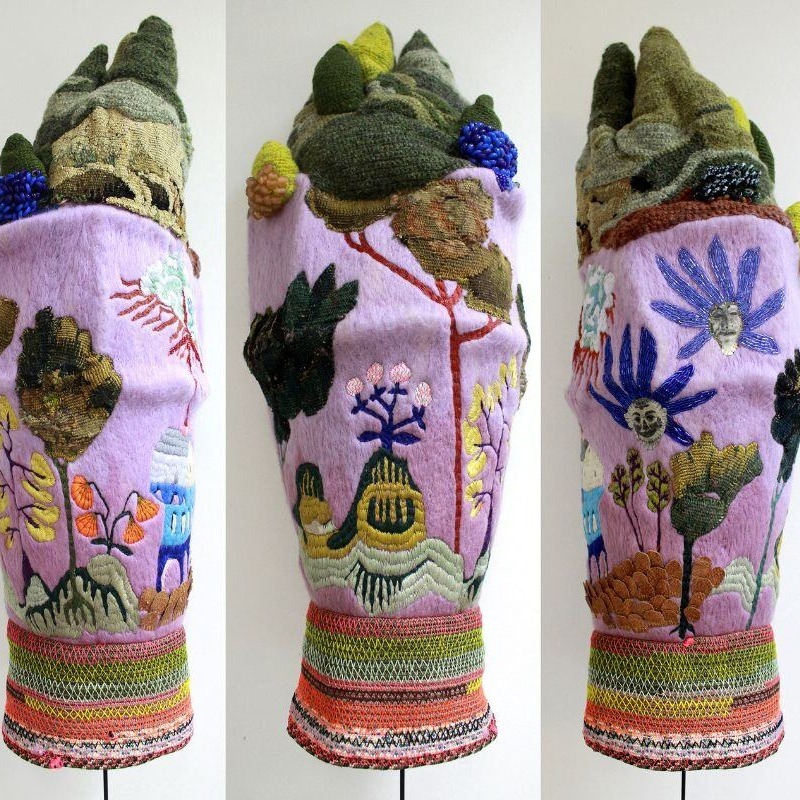
Textile artist Séverine Gallardo shares her unique work & inspiration in a Friday Feature Artist interview with Take Two
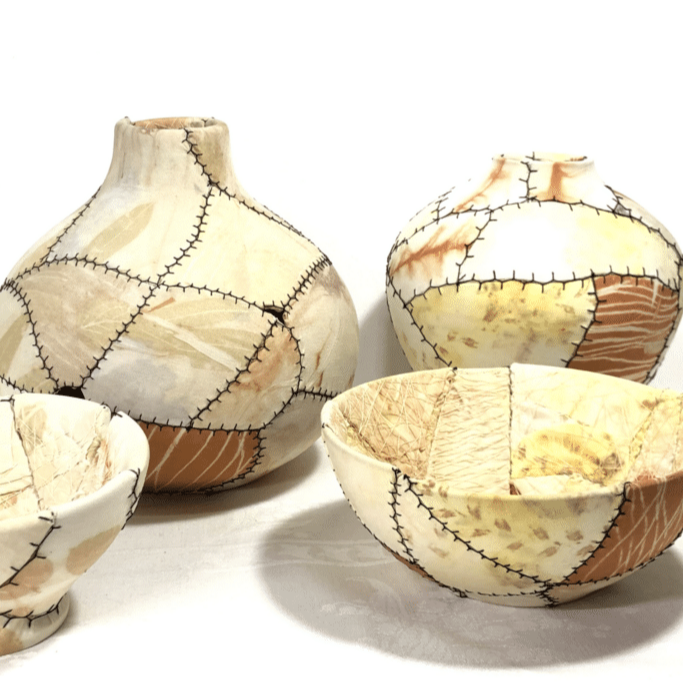
Tamara Russell uses her art to spread awareness of many social issues in Australia. Take Two spoke with Tamara about her art, life, and passions.