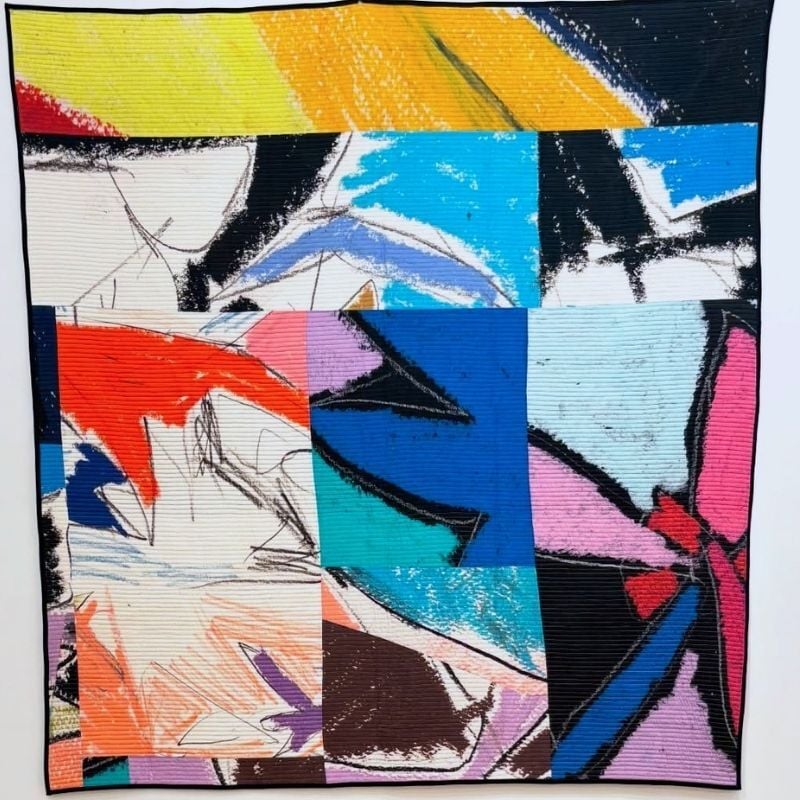
There's real comfort in using a good quilt pattern. The blocks are planned, the measurements are done, and you have a fair idea of how it will turn out.
But maybe you've started to wonder what would happen if you put the pattern down. What if your quilts grew from your own ideas, and became art that's unmistakably yours?
Here's how to move beyond traditional quilting patterns and into contemporary quilting, one step at a time.
Patterns are a good teacher
Patterns teach things that are hard to learn any other way, like how seams sit and how a grid keeps a design steady. And that knowledge stays with you, even when you decide to leave patterns behind.
Remember, moving beyond a pattern doesn't mean throwing it out, or losing that knowledge. You get to decide what stays.
Move beyond the pattern one change at a time
Here’s some ways to get started:
-
Choose a pattern you know well, and change a single thing.
-
Maybe swap the colours, enlarge the blocks, rotate them, or rearrange the layout.
-
Next time, change something else.
If you've made a nine-patch block, for example, try making the centre square much bigger than the rest, or leave out every other block and let plain cloth fill the gap.
Small experiments like this build confidence quickly. After doing a few of them, you'll notice which changes feel right to you.
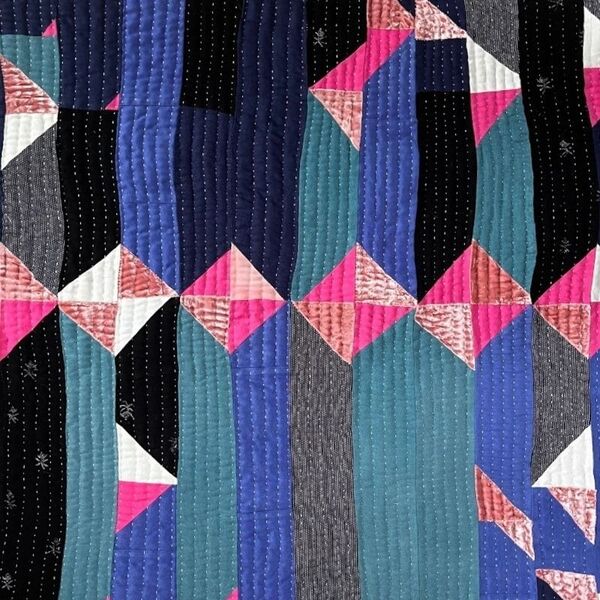 Quilt artwork by Amand Nadig
Let colour lead
Colour is one of the quickest ways to make a quilt feel like yours. Instead of choosing fabrics to suit a pattern, choose the colours first and let the quilt design follow their lead.
If you're wondering how to choose quilt colours without a rulebook:
-
Start with something that already moves you: a photograph, a favourite room, or the sky at a certain time of day.
-
Pull out three to five colours from it, then decide how much of each colour you want in your quilt.
-
Proportion matters as much as the colours themselves, because a small amount of a bright shade can lift a quilt made mostly of quieter ones.
Quilt colour schemes don't have to follow a formula. Instead, adapt ideas from art colour theory - such as contrast and harmony - to give you a starting point. Test your ideas with your own eyes, by checking how your fabrics sit together, by squinting at them or taking a black and white photo. Light and dark often do more work than the colours you pick.
.jpg?width=700&height=525&name=Quilt%20artwork%20by%20Julian%20Jamaal%20Jones%20(2).jpg) Quilt artwork by Julian Jamaal Jones
Quilt artwork by Julian Jamaal Jones
Sketch before you cut
Before you touch the fabric, spend 10 minutes drawing, using loose lines and a few shapes. Or try cutting shapes from paper and moving them around until the placement feels right.
Some other things to try:
-
Pay attention to the empty space as well as the shapes.
What you leave blank defines the design as much as what you fill, and positive and negative space working together is often what makes a composition feel deliberate. -
If drawing feels daunting, start with a feeling instead.
Think of a piece of music or the mood of a particular day, and ask what shapes and colours it would be. Something loud and fast might be sharp angles and strong contrast, while something slow and quiet might be soft shifts and plenty of space.
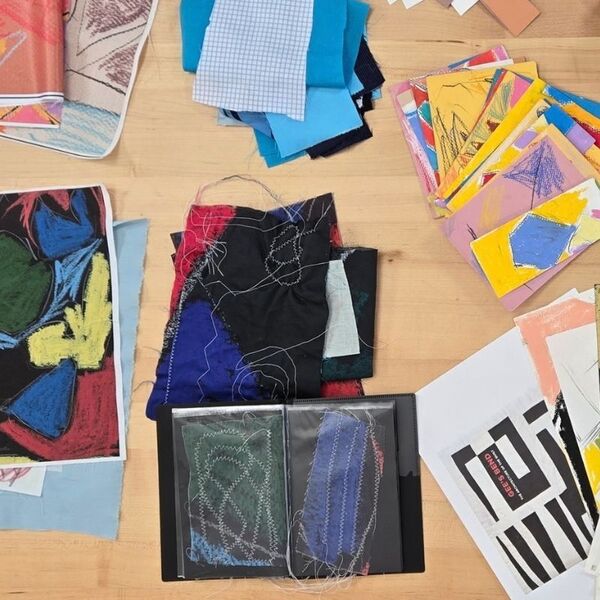 Julian Jamaal Jones' studio table - work and planning in progress
Work with scraps and let the quilt grow
Scraps are a great way to simplify the choices you have to make when you're learning how to move beyond quilting patterns.
Step 1: Gather some scraps and pick a few pieces that speak to each other.
Step 2: Try adding one piece at a time, responding to what's already there rather than following a plan. That's improvisation at its simplest, and because each decision is small, none of them feels risky.
Step 3: Stitching can join in, too. Hand quilting lines can echo a shape, add texture, or draw something new across the surface.
Work small, make multiples and test ideas
Small quilting pieces are a low-risk way to try new ideas. They use less fabric and can take less time, which makes it easier to attempt something that might not work.
Try making the same piece three times, changing something each time, such as the colour palette or the composition (or make a bolder change if you really want to test something new). Seeing the versions side by side shows you what you keep returning to.
As you go, keep a few notes or take a photo at each stage. Looking back later helps you see which decisions you’d make again, and which you’d happily leave behind.
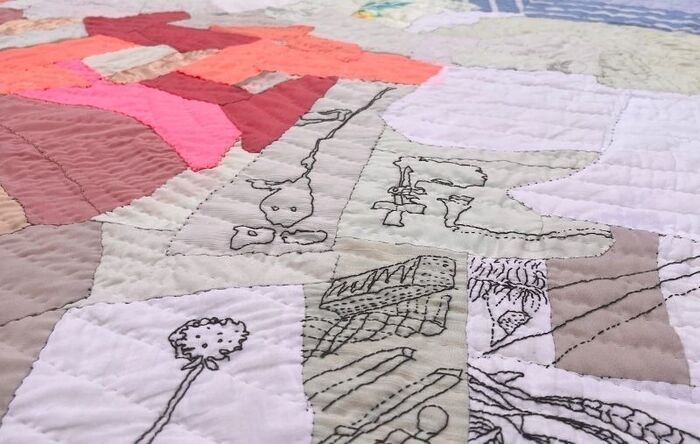 Close up of quilt artwork by Amanda Nadig
Trust your own eye
Moving beyond traditional quilting patterns mostly means giving yourself permission to use the skills you already have - piecing, pressing and stitching - in a new way. Trust the decisions that feel right, and you’ll be on your way to creating your first contemporary quilting piece.
If you'd like company and guidance while you step away from the pattern, two upcoming Take Two courses take it in different directions. In Gesture, Colour, Quilt: Abstract making, Julian Jamaal Jones explores colour, abstraction, and composition, helping you build quilts that feel intentional and personal. In Fabric Freedom: Improvised quilts, Amanda Nadig focuses on working intuitively and by hand, using repurposed fabric and scraps.