Willemien de Villiers: Automatic writing

Artist Willemien de Villiers shared time with Take Two to talk about her art, writing and growing up in South Africa.

Willemien de Villiers: Automatic writing


Creative beginnings

For Willemien, creativity began with writing, “Probably the first creative act I can remember was when I learned how to write,” she says, “I’m not sure it’s taught in schools, but how to write by hand beautifully. That practice of all the loops at the top. I have such a memory of getting lost in the patterning when you had to do all your S’s and your J’s and the G’s; that was an awakening for me. That pattern probably would always play a role in my life. And, from there on, it grew.” 

Writing was just the beginning for Willemien, and she knew creativity would be part of her life, “I was quite a solitary child,” she says, “even though I’m one of seven. I’ve never felt very connected to my brothers and sisters; even now, I’m connected to only one sibling, a strong connection. So, I was a bit of an observer, a child who liked to go off by herself and play with leaves and sticks. And I always knew instinctively that I would follow a creative path.”


Hillary Waters Fayle: Alive in Beauty
 

Previous lives of textiles

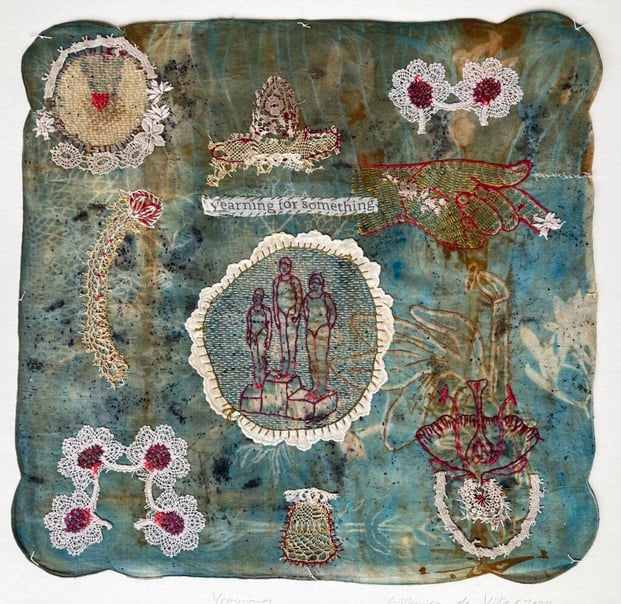
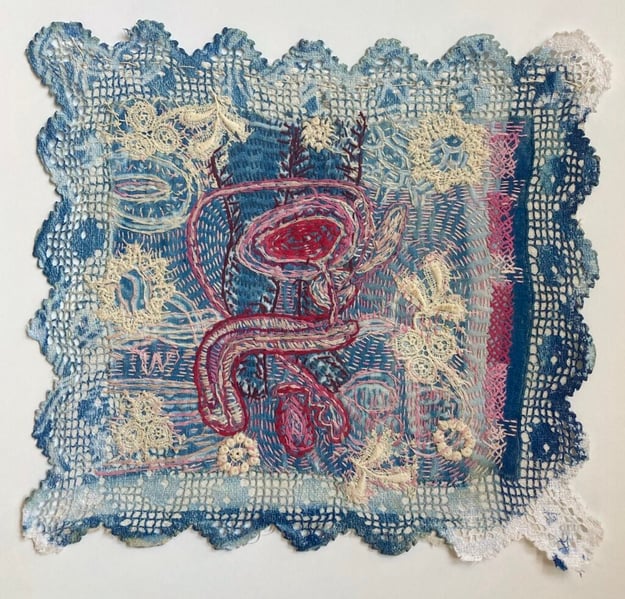
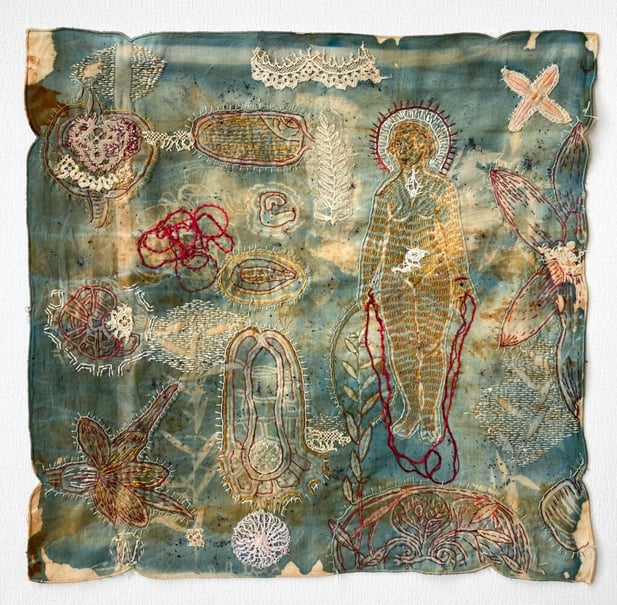
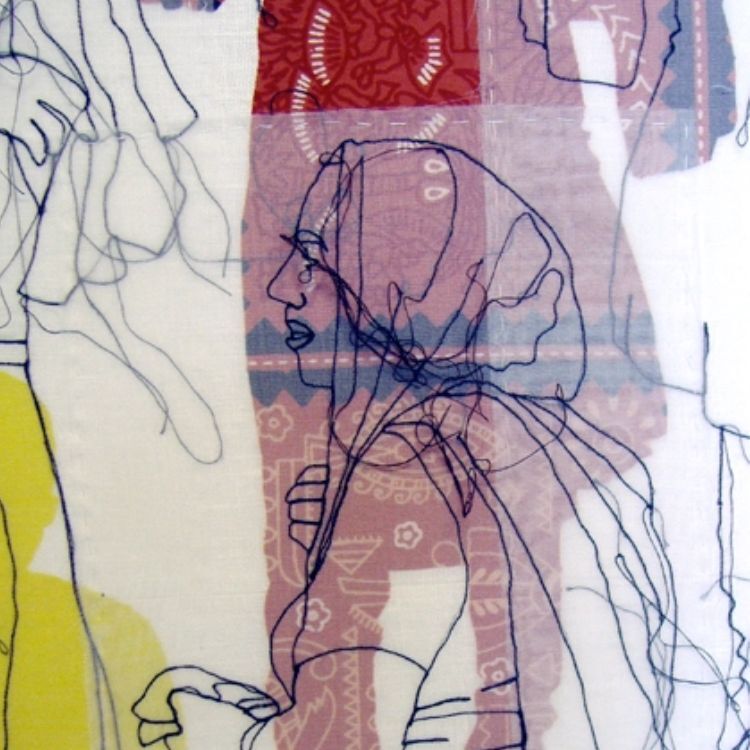
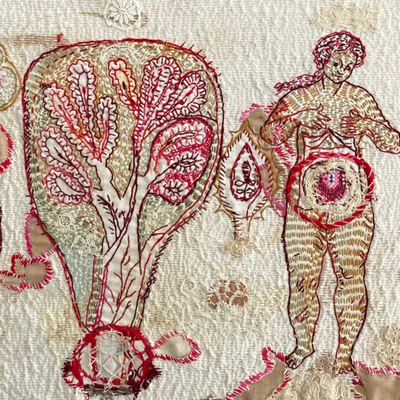
Willemien finds it vital when she works with textiles that she chooses a natural fabric and that the fabric has had a previous life, “I like to forage in thrift stores and charity shops,” she says, “and people who know me very well will gift me things that they can’t use anymore. And the more torn and stained and used, the better for me because I do sense a story that’s very important.” 

Her choice of materials is an integral part of her work, “I only use proper embroidery floss”, says Willemien, “I was very lucky that somebody gifted me a massive box of DMC threads that she said she would never use. I will never have to buy a single strand of floss in my lifetime again. That’s what I’m drawn to, and anything, what I call female notions, all those little haberdashery notions, that keep us together; the bra straps and that sort of upholstery that the female body seems to need, I love them. I love them as fun little objects and to use in a subversive way in my works.”

South African stories

Willemien’s work is a reflection of the struggles of living in South Africa, “I’m a white person in South Africa,” she says, “I was born in a very, very repressed era of apartheid that afforded me certain privileges and protection. So, I am working from a point of view that I’ve never been oppressed because I’m white. I am oppressed, in theory, because I’m female, and I think that’s true for a lot of people. I’m always aware of juggling many different realities of where I come from and my place in this difficult country. Nobody can help how and where they are born, the body they’re born into. You are given a certain body and circumstances. But I think I was very aware from a very young age of separateness that the old oppressive National Party regime pressed down on us, of us and them: they are black, we are white, they are different, we are not the same, and when you’re a young child, you feel unease, it’s damaging, it’s hugely damaging. When that happens, it’s more damage to the oppressed people.”

This is why Willemien uses her work as a form of healing, “I think, for me,” she says, “perhaps I’m stitching because it is a constant healing that needs to happen. I am constantly looking for ways of making sense because, in a way, I can’t make sense. In one lifetime, one can’t make sense of what was done to the vast majority of people in a beautiful country that is mind-blowingly beautiful but with so much hurt and pain that is still evident. My work is a constant process of finding connections, especially the connections to find my play in this difficult place where I live.”


Hillary Waters Fayle: Alive in Beauty


The power of words

Willemien’s go-to for any situation where she feels unsure of herself is to start writing.

“As soon as I could put my thoughts into words,” she says, “that’s what I did, and it’s still my go-to. Yesterday, I took myself off and sat some way and just wrote because there were things I needed to work through.”

Free writing, in particular, Willemien finds very cathartic, “It comes very naturally to me,” she says, “there’s a release in it. And even reading in a very absent-minded way. I love the look of words. I grew up in an Afrikaans house; English is my second language, and my mother read a lot of English because her mother was an English teacher. We had a lot of English books in our home, but for a long time, I didn’t understand a word.  I would read it because the patterns made sense to me. So I think language, in a very abstract way, helps me make sense of things.”

Just start

Willemien’s advice to budding artists is to start, “Everybody is different,” she says, “all I can say is that you just have to start. And for me, again, it is through writing. And that’s what I, in my own workshops, explore a lot because there’s such a fear of this emptiness, whatever it is. You have a canvas or a piece of cloth, and now you must start. But it’s a process. So the only thing I can say is, start, just start somewhere. And if it is that you need to write for days and days and days about why you don’t know what it is that you are trying to say, then that’s where you start, or otherwise, just start and see where it goes.”


Hillary Waters Fayle: Alive in Beauty


About the artist

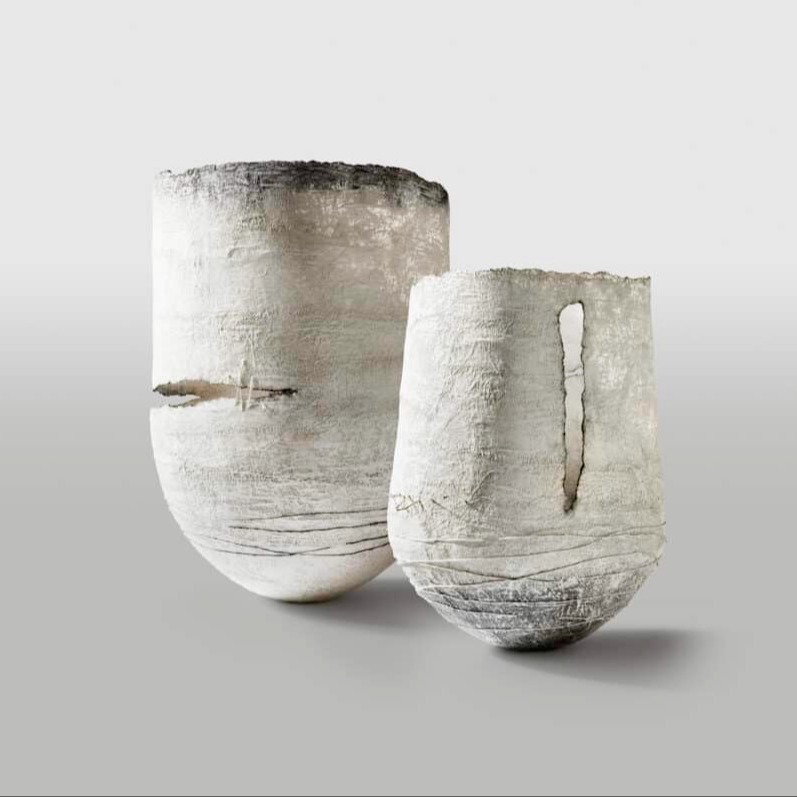
Willemien de Villiers was born in 1957 in Pretoria, South Africa. She studied fine arts at the University of Pretoria, graduating in 1978. Currently based in Muizenberg, Cape Town, Willemien also writes, paints and works with ceramics.

In her work, Willemien de Villers searches for a balance between universality, stability, change and growth. She shows that beauty can be created in the wake of trauma and rupture and that through our desire to challenge existing norms, we can connect to create a more carefully considered and thoughtful system.


4 min read

Join our community

A newsletter for visual artists, trusted by more than 80,000 creatives around the world.

❤️

Related Stories

Gizella Warburton: What Isn’t There

1 min read

Gizella Warburton: What Isn’t There

Gizella Warburton is a fine artist whose practice is infused with texture, intuition and reverence. Mark making is an intrinsic part of Gizella’s...

Read More
Wen Redmond: Making Art by the Seat of the Pants

1 min read

Wen Redmond: Making Art by the Seat of the Pants

Wen Redmond is an internationally recognised mixed media and fibre artist, known for her unique use of fibre, combining photography, paint and...

Read More
Donna Watson and becoming the journey

1 min read

Donna Watson and becoming the journey

Donna Watson is a mixed-media collage artist. Her process incorporates layers of paint by mixing cold wax with oil paints. She then layers,...

Read More
Zimmi Forest: The Art World, Foraging and Ethics

1 min read

Zimmi Forest: The Art World, Foraging and Ethics

“I came to art through a passion for sustainability and the environment. I create work with nature, about nature and in nature.” This is the...

Read More