1 min read
Student Success Story: Tanja Gawin
Tanja Gawin is a German-born fibre artist living in Melbourne, Australia. Her creative life has unfolded over many years and through several...
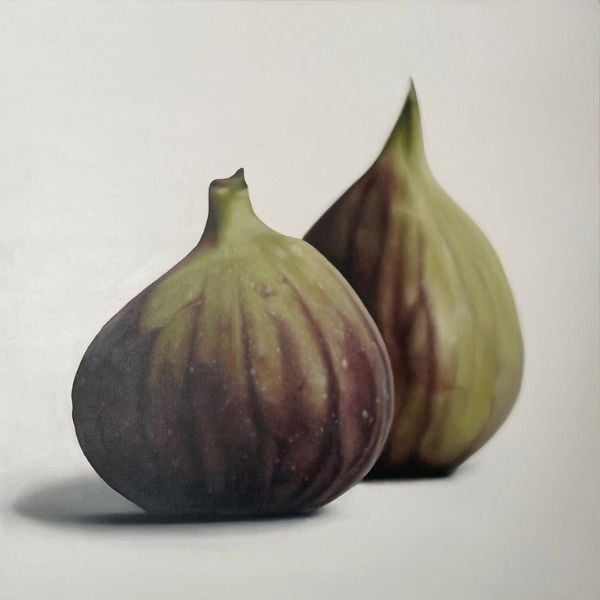
Mardi Busby lives in the semi-rural, leafy outer suburbs of Melbourne, Victoria, and has been a practising artist for more than 20 years. Her background spans graphic design, photorealism and abstract painting, giving her a deep understanding of composition, visual language and the technical demands of making art. Yet despite that experience, Mardi had reached a point where something in her practice no longer felt fully alive.
Her realistic paintings were technically accomplished, while her abstract work gave her more freedom and a stronger connection to earthy, unstructured forms. Even so, there remained a sense that something was missing. She was still creating, still experimenting and still producing work she valued, but the joy of discovery had begun to fade.
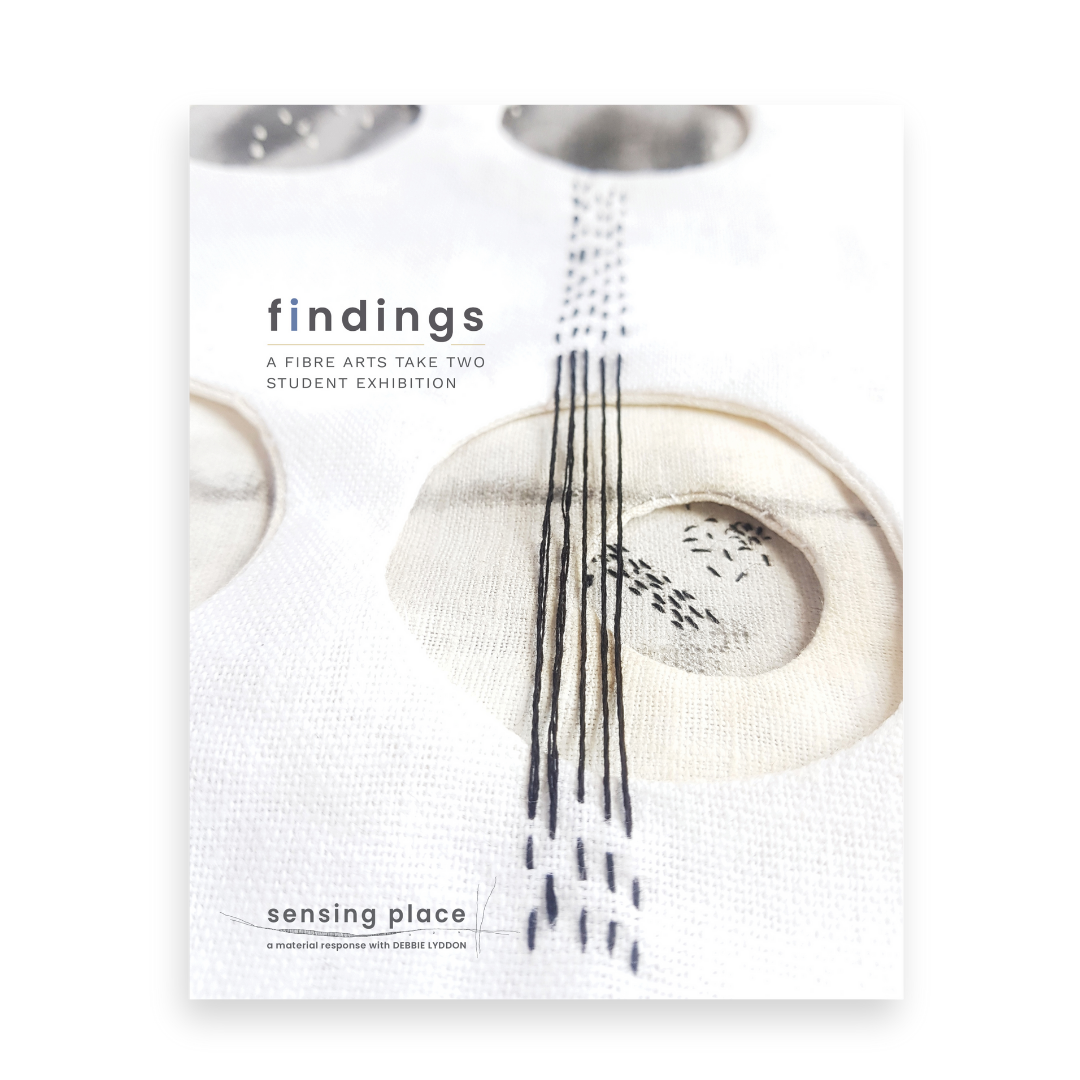
When Take Two and Debbie Lyddon’s Sensing Place course appeared unexpectedly in Mardi’s Instagram feed, she was initially unsure. Fibre was far outside the painting practice she knew so well. Yet the very fact that it felt unfamiliar would become the reason the course mattered.
Mardi had spent many years developing a sophisticated painting practice. Earlier work in photorealism demanded precision, control and considerable technical skill, and she loved the results she was able to achieve. At the same time, the process itself began to feel limiting.
Realism offered little space for the kind of unpredictability Mardi increasingly wanted from her work. She knew how to create the image, knew how to resolve the composition and understood the principles that made a painting work. The problem was that knowing so much had begun to remove some of the surprise.
Abstract painting gave her more room to breathe. Mardi was naturally drawn to raw surfaces, earthy palettes and a less structured visual language, and abstraction allowed her to explore those qualities more freely. Still, even there, familiarity had started to creep in.
She had become comfortable.
That comfort was not necessarily a bad thing, but Mardi recognised that she needed something that would interrupt it. She wanted to return to exploration, to work with materials she did not already understand and to feel once again that anything might happen.
Mardi first encountered Debbie’s work through an advertisement for Sensing Place on Instagram. Her immediate reaction was mixed. She was intrigued by what she saw, but fibre felt like an entirely different world.
Then the materials began to catch her attention.
Rust, bitumen, ink, salt, fabric and weathering appeared throughout Debbie’s work, used in ways that felt contemporary, raw and materially alive. The course did not resemble Mardi’s existing painting practice, and that difference became increasingly appealing.
“I really needed something different to shake me up and to reignite my joy and play within the studio.”
Mardi waited until the final day before enrolling. There was hesitation, but beneath it was a strong sense that the course might offer exactly the disruption she needed.
Once she began, that instinct was confirmed.
Mardi did not enter the course expecting a complete change of direction. Initially, she imagined that fibre might simply add another dimension to her abstract paintings. Perhaps there would be some stitching, pieces of fabric or metal incorporated into the surface.
What she really wanted, however, was something less tangible.
She wanted play.
After years of experience, Mardi understood much of what was happening when she made a painting. She could anticipate how materials behaved, how a composition might resolve and which decisions would produce a particular effect. Beginning again with fibre removed that certainty.
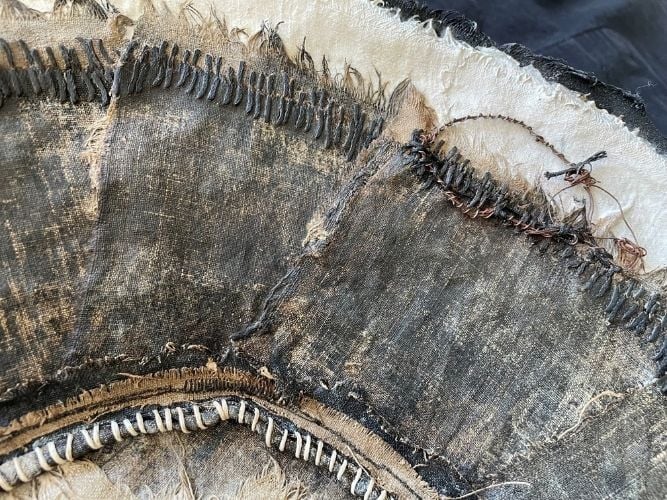
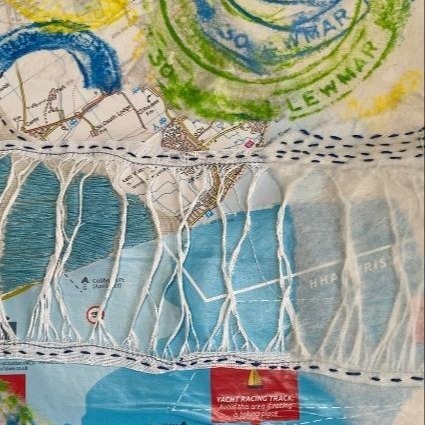
Fabric behaved differently. Stitch became a mark-making tool rather than a practical skill. Rust moved into cloth unpredictably. Bitumen bled through surfaces. Torn edges, stained fibres and weathered materials resisted being controlled in the way paint sometimes could.
The unfamiliarity was liberating.
Mardi was no longer drawing primarily on what she already knew. She had to respond, test, fail, alter and try again.
One of the first moments that shifted Mardi’s thinking came through Debbie’s use of rust.
Watching rusted metal interact with cloth immediately captured her imagination. Debbie created openings in the fabric, introduced metal and allowed the rust to migrate into the material, producing marks that developed through the process rather than being deliberately painted onto the surface.
The unpredictability of it appealed to Mardi.
Then the course moved into three-dimensional work.
That was the point where everything truly landed.
“When we got to the three-D modules, that just took it to a whole other level for me. That’s where I found my niche.”
Three-dimensional work brought together many of the qualities Mardi had been searching for. It was tactile, raw, organic and open-ended. The work could be built rather than simply composed on a flat surface, and the materials themselves became active participants in the process.
She was no longer simply interested.
She was off and running.
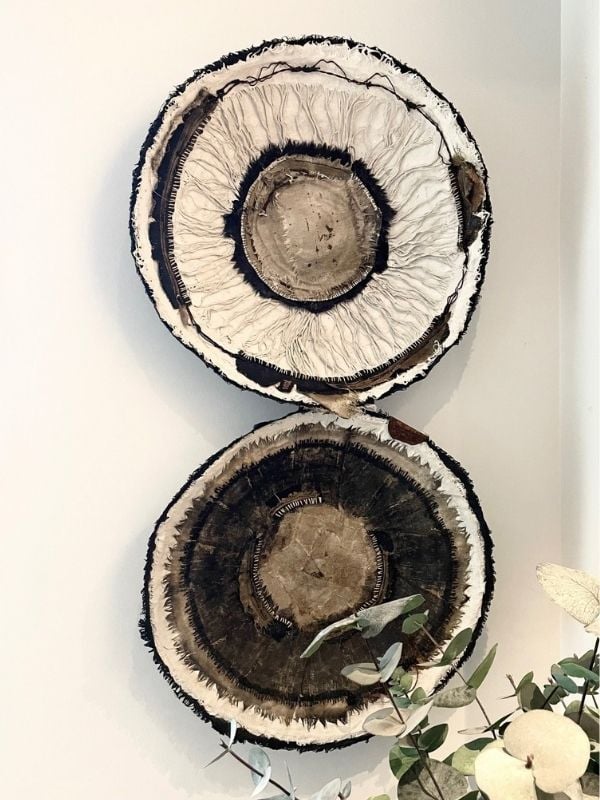
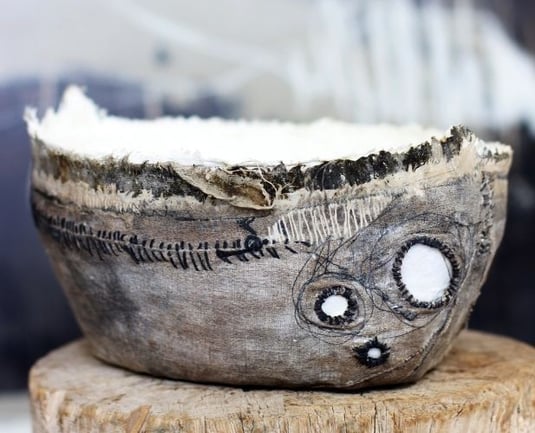
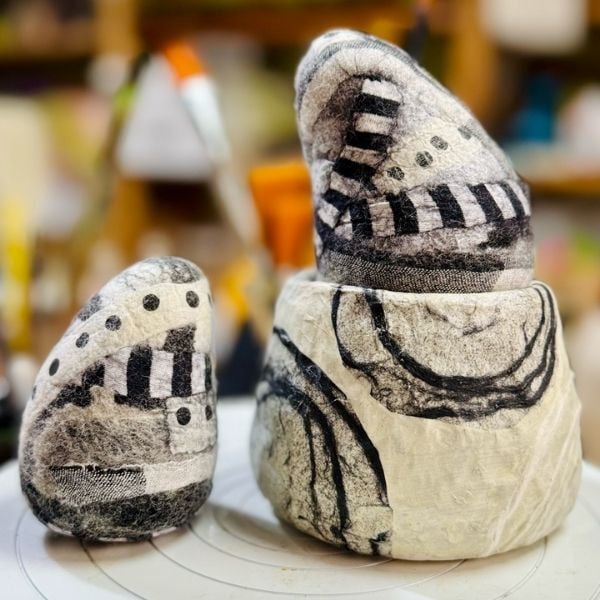
Mardi began making vessels and baskets, bringing together rusted cloth, bitumen, ink, thread and stitching in ways that felt entirely new.
The transition did not erase her painter’s eye. Her understanding of composition, balance and visual tension remained present, but it was now being applied to form rather than a flat surface. The experience she had built over decades became something she could draw upon without allowing it to dictate the outcome.
One early vessel incorporated rusted wire circles, dyed fabric, machine stitching and hand stitching. Mardi recognised almost immediately that the piece had opened another direction for her.
It was not perfect, nor did it need to be.
What mattered was the question it raised: where could this go?
That question became far more important than arriving quickly at an answer.
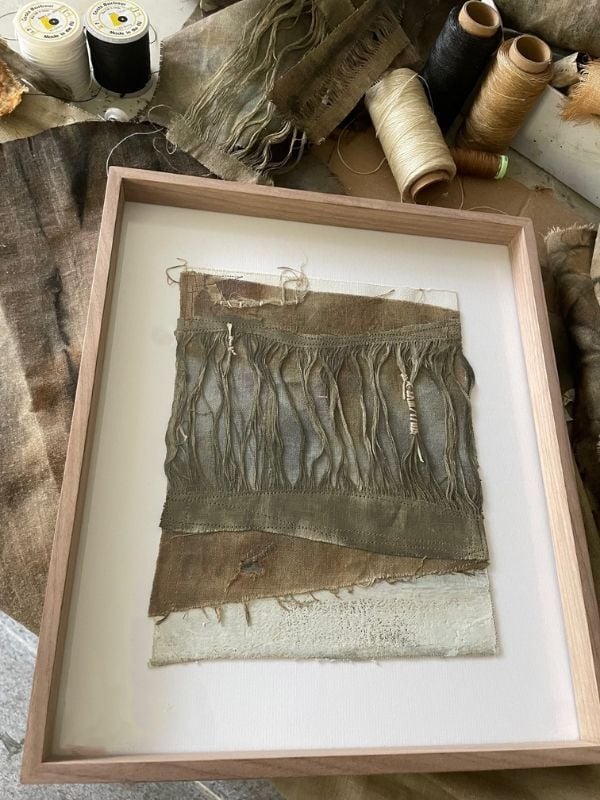
Another unexpected development came through Mardi’s sewing machine.
She had owned the machine for more than 40 years and had used it in the past to make clothes for her children. It was familiar as a practical tool, but she had never fully considered its potential as a drawing instrument.
Through the course, stitching became something else entirely.
Lines could be loose, gestural and abstract. Thread could pull, bind, disrupt or structure a surface. The machine could create marks with the same freedom Mardi had once sought through paint.
That shift was significant because it transformed something already sitting quietly in her studio into a completely new creative tool.
She had not needed another piece of equipment.
She needed another way of seeing what she already had.
One aspect of Debbie’s teaching that particularly resonated with Mardi was that the course did not ask students to reproduce Debbie’s work.
Techniques were demonstrated clearly, but they were offered as tools rather than formulas. Students were encouraged to interpret them through their own visual language and consider how each process might connect with their existing ideas.
For an established artist, that distinction mattered.
Mardi was not looking to adopt somebody else’s aesthetic. She wanted to expand her own.
Debbie’s teaching encouraged her to think more broadly about materials, meaning and response. Even after more than 20 years of artistic practice, Mardi found herself stopping to reconsider assumptions she had carried for years.
The technical learning mattered, but so did the thinking behind it.
The course allowed Mardi to ask not only how something could be made, but why a particular material, mark or form belonged in the work.
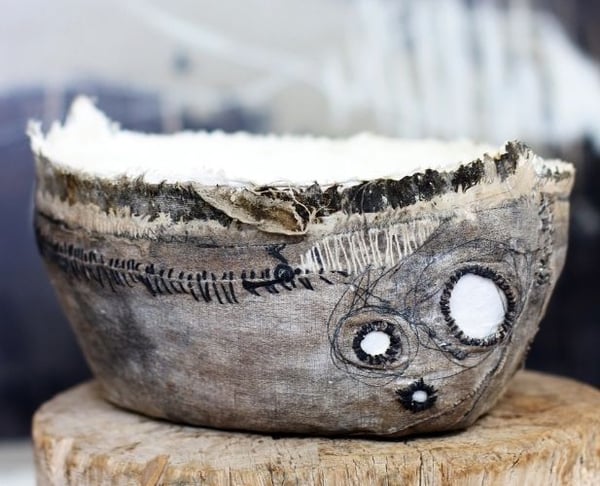
Rust, bitumen, salt, waxed linen thread and stained cloth quickly became more than new techniques to try.
Mardi began responding to their physical qualities.
She loved the earthiness of the materials, their rawness and the evidence of process left on their surfaces. A stain did not need to be perfectly controlled. A torn edge did not need to be corrected. Rust could spread beyond its intended boundary and still become part of the work.
The materials carried history simply through the way they changed.
This offered Mardi something different from painting. Instead of constructing every visual effect herself, she could create conditions and then respond to what happened.
That willingness to allow materials some agency brought spontaneity back into her practice.
The process became less about executing an idea and more about discovering one.
When Mardi enrolled, she imagined that Sensing Place might slightly expand the surface language of her abstract paintings.
The reality was considerably larger.
“It’s totally changed my practice.”
Her two-dimensional work has not disappeared, and Mardi still expects abstraction to remain part of what she does. But fibre and three-dimensional form have moved rapidly from the edges of her practice towards the centre.
She is now deeply interested in vessels, baskets and sculptural wall work, exploring how fabric can be stained, pulled, stitched, shaped and transformed.
This was not a deliberate career pivot mapped out before the course.
It emerged through making.
The further Mardi moved into the material, the clearer it became that she had found a language capable of holding the qualities she had long been drawn to: earthiness, irregularity, texture, rawness and form.
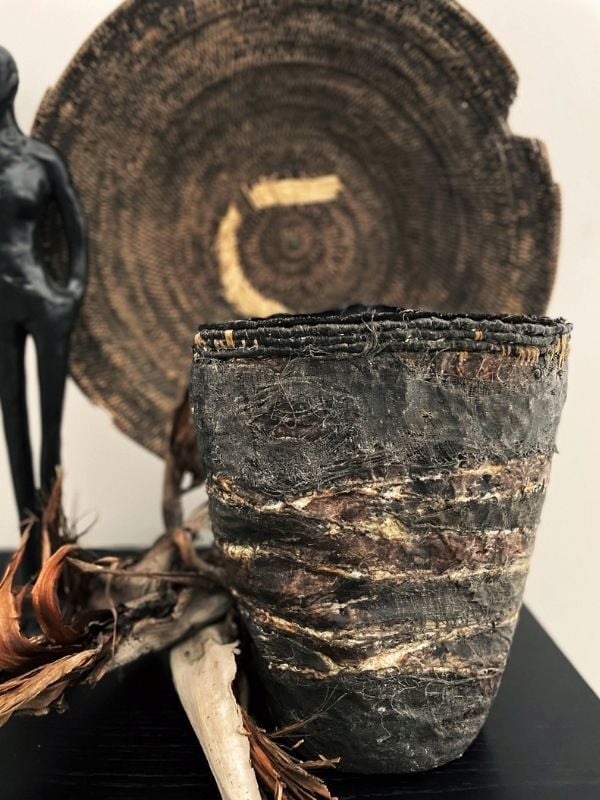
The most meaningful change, however, is not visible in the materials.
It is visible in Mardi’s relationship with the studio.
Before the course, she had begun finding reasons not to make. There was procrastination, hesitation and a subtle resistance to entering the space. The work was still there, but the pull towards it had weakened.
Now the opposite is happening.
Mardi wakes eager to return to the studio. Sometimes an idea continues after dinner and she finds herself wandering back in wearing her dressing gown because waiting until morning feels too long.
“I can’t wait to get in here in the morning.”
That urgency has become one of the clearest signs that something fundamental has shifted.
Mardi describes the difference as finding heart in the work again. Her practice is no longer guided primarily by what she knows will look resolved or satisfy familiar design principles. There is more emotion, curiosity and instinct in the decisions she makes.
The course did not give her technical competence. She already had that.
It gave her back hunger.
Perhaps because the work feels so new, Mardi is also resisting the temptation to rush it.
Interest in the vessels has already begun arriving from other people, but she is conscious that she does not want external momentum to interrupt the exploration too soon. She wants time to understand what the work might become before deciding where it belongs.
That attitude is important.
After years of knowing how to make finished work, Mardi has given herself permission to be a beginner again.
She does not need every experiment to lead somewhere immediately. A basket can simply be an investigation. A vessel can raise another question. A rusted piece of fabric may sit in the studio until the right context presents itself.
“It’s not about rushing the process, it’s about enjoying the process.”
That may be one of the greatest changes of all.
Mardi is now looking towards larger and more ambitious three-dimensional work.
The vessels and shallow baskets she has already created have opened ideas around scale, installation and sculptural wall pieces. She is interested in seeing what happens when the intimate objects she has been making become larger and occupy more physical space.
There is no rigid plan yet.
That is intentional.
Mardi wants to keep investigating fabric, dye, rust, stitching and the many other processes that can alter and transform a surface. She can imagine vessels becoming larger, forms moving onto walls and the work evolving again into something she cannot yet predict.
Her abstract paintings will continue, but they may now sit alongside an expanding fibre practice rather than carrying the entire weight of her creative expression.
For an artist who enrolled hoping simply to add another element to her existing work, the change has been substantial.
A learning experience built around support
Mardi’s advice to someone considering Sensing Place comes with the perspective of an experienced artist who almost talked herself out of enrolling.
She waited until the last day.
Her hesitation had little to do with the quality of the course and everything to do with the fact that the material felt outside her existing practice. Fibre was unfamiliar, and there was no certainty that it would belong within the world she had already built as a painter.
That uncertainty turned out to be precisely where the value lay.
Mardi believes the course can offer something to both experienced artists and those earlier in their practice because it encourages experimentation without prescribing what the finished work should look like.
Her advice is simple.
Take the leap.
For Mardi, that decision expanded far beyond learning a new set of techniques. It reopened the studio as a place of curiosity, gave her permission to play again and introduced a material language she now wants to explore much further.
She entered expecting to add a little fibre to her paintings.
She came away wanting to see just how far fibre could take her.
1 min read
Tanja Gawin is a German-born fibre artist living in Melbourne, Australia. Her creative life has unfolded over many years and through several...
1 min read
When Sara stumbled upon Take Two, she wasn’t looking for a new path – she was searching for reconnection. “I was quite lacking in confidence,” Sara...
1 min read
Meet Lori Cook. A retired nurse, devoted mum, and fibre artist who, for years, quietly held onto the dream of creating more than just quilts. Like...