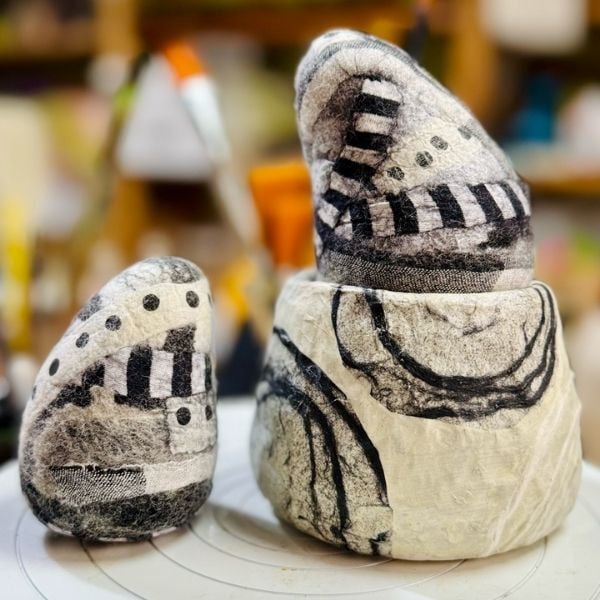
Tanja Gawin is a German-born fibre artist living in Melbourne, Australia. Her creative life has unfolded over many years and through several different chapters, from studying interior architecture in Germany to working in social services and palliative care in Australia. Today, wet felting sits at the heart of her practice, supported by an ever-growing curiosity for structure, surface, stitching and the possibilities that emerge when different materials come together.
Tanja’s relationship with Take Two has developed gradually over several courses, each one adding another layer to her practice. Rather than looking for a complete reinvention, she approaches learning as a way of expanding what is already there. When she discovered Sensing Place - A Material Response with Debbie Lyddon it was not only the materials and techniques that drew her in. It was the sense of joy radiating through Debbie’s work and teaching.
The timing of the course would prove significant. Tanja’s mother had become seriously ill, and the emotional weight of that period sat alongside the everyday demands of a demanding career. In the midst of it, Debbie’s course offered something Tanja values deeply in her creative life: joy, ease, focus and a place to restore balance.
From architecture to the freedom of felt
Tanja’s creative foundations began with a formal education in interior architecture in Germany. The training gave her an understanding of structure, space and how three-dimensional forms fit together, but it also made something else clear. Precision and straight lines were never where she felt most at home.
Life drawing and freehand sketching were always the subjects she gravitated towards, perhaps offering an early indication of the more intuitive direction her creativity would eventually take. After graduating, she worked in architecture for only a short time before recognising that it was not the right fit.
A move to Australia, raising a child and a long career in social work followed. Creativity remained present in the background, but it was around 12 years ago that fibre began to pull Tanja back towards making in a more sustained way.
The rediscovery began with a stash of wool left over from her daughter’s childhood knitting. That wool led Tanja to a book about wildly inventive tea cosies, and soon she was knitting colourful, exaggerated forms simply for the pleasure of it. Yet counting stitches and following precise patterns quickly felt too restrictive, and wet felting opened a different door.
Felt gave Tanja the freedom she had been looking for. It allowed her to work with colour, shape and material directly, responding instinctively rather than following a rigid plan. From there, a practice began to grow.
Following the red thread
Tanja describes a “red thread” that runs through everything she makes and every course she takes. New skills are not treated as separate exercises to master and then leave behind. Instead, they are absorbed into the practice she already has.
What she makes changes each time she learns something new, but the core of the work remains recognisably hers. A technique from one course might reappear years later in an entirely different context, while an older felt vessel can suddenly become the starting point for something new.
Tanja often returns to pieces already sitting on her shelves and asks what else they might become. She might add paper, wire, stitching, drawing or another felt element, allowing work to evolve in stages rather than treating completion as something absolute.
For her, the Take Two courses have not changed her practice so much as continually added to it. Each one becomes another layer within a growing creative vocabulary.
When joy became the deciding factor
Tanja has always enjoyed online learning, particularly the freedom to move at her own pace, revisit lessons and experiment independently. Since discovering Take Two several years ago, she has chosen courses largely by instinct. Often it is the student work that first catches her attention, followed by a desire to see how the techniques might translate into her own felt practice.
When Tanja came across Debbie Lyddon’s course, the response was more immediate.
“What jumped out was her joy, the pure joy that radiated from the screen.”
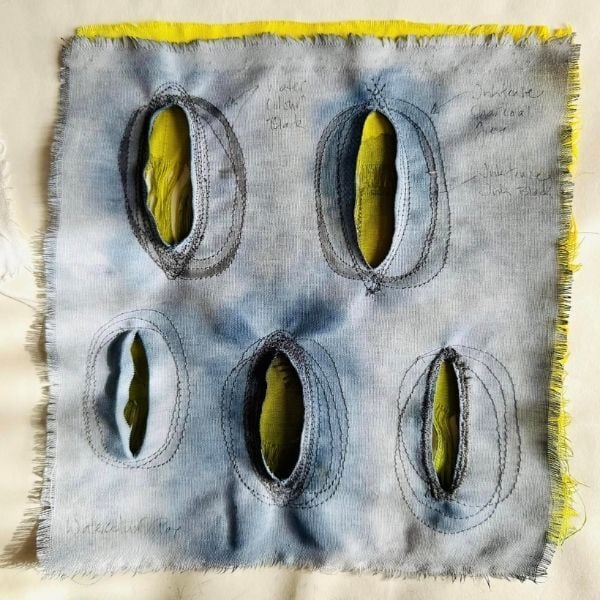
Tanja was drawn to Debbie’s layering, her use of windows and the glimpses of hidden surfaces beneath the work, but it was Debbie’s energy that ultimately made the decision for her. Joy is one of the strongest motivators in Tanja’s own work, and she instinctively gravitates towards artists and teachers whose practice carries that same sense of delight.
She does not want art to feel heavy or punishing. The rest of life already asks enough of her.
A little book of cheer in difficult times
The course began during an emotionally difficult period. Tanja’s mother had become seriously ill, and she received painful news early in the course. Suddenly, the act of making sat alongside uncertainty, grief and the beginning of a long process of saying goodbye.
One project became particularly meaningful.
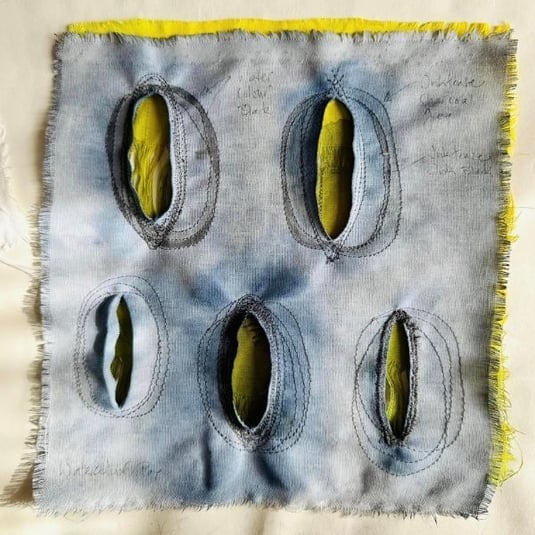
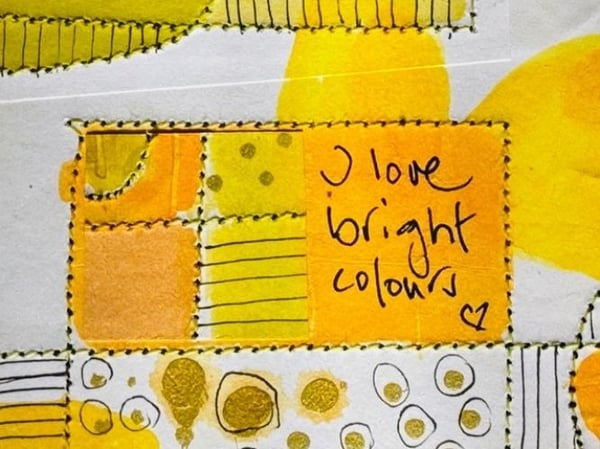
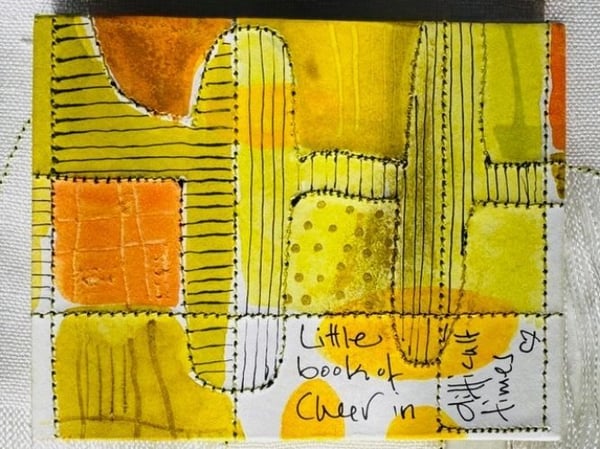
Tanja created a small handmade book that she titled Little Book of Cheer in Difficult Times. The scale of the piece made it manageable, and the repetition of stitching on her trusted old Bernina sewing machine gave her something gentle and tangible to focus on.
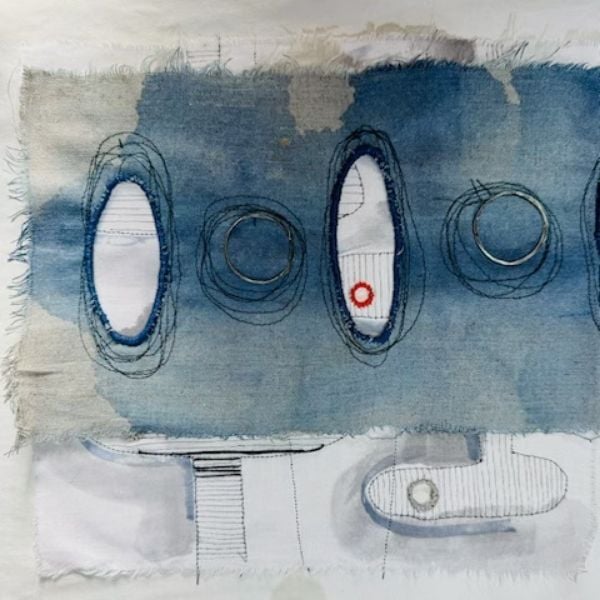
She made several of the books
They were not an attempt to make sense of what was happening or to transform grief into something profound. Their value was much simpler. They gave Tanja a place to create small moments of cheer at a time when she needed them most.
The experience reinforced something she already understood intuitively about her practice. Art did not have to solve the difficulty in her life. It could simply help her live alongside it.
Art as a place to restore balance
Tanja works in palliative care, so emotional intensity is already part of her professional world. She understands illness, dying and the natural order of life through both her work and personal experience. That knowledge does not necessarily make grief easier, and it has also shaped what she asks from her art.
“I don’t want challenges in my artwork. I want joy, ease and flow.”
For Tanja, creativity is restorative rather than confrontational. She is not looking for another problem to solve when she enters the studio. She wants the pleasure of colour, material and form, and the freedom to follow an idea without pressure.
This understanding guides many of the choices she makes around learning. The courses that nourish her are often those that invite experimentation without taking away the joy of discovery.
Debbie’s course arrived at exactly the right moment because it supported that need. It gave Tanja new material possibilities while also providing a place of steadiness during an emotionally demanding period.
Discovering more in the layers
The material language of Debbie’s work resonated strongly with Tanja. Layering, windows, openings and the possibility of seeing one surface through another immediately connected with her instinctive interest in three-dimensional form.
Rather than abandoning felt, Tanja began asking how Debbie’s methods could become part of what she already did. This has always been the way she learns. Techniques are most useful when they can be adapted and absorbed into her existing practice.
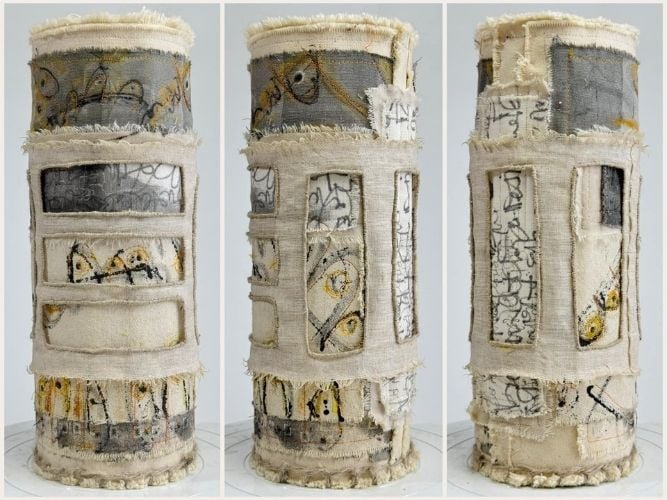
One vessel became a particularly clear example of this integration. The shapes began with seaweed Tanja had sketched while walking along the beach. She translated those shapes into canvas, adding stitching, fine-liner drawing and layered windows that allowed glimpses into the surface beneath.
A glass vase was incorporated inside, giving the piece a practical function while retaining its sculptural character. The vessel even acquired what Tanja affectionately describes as a little vest, another layer hinting at what might be hidden underneath.
For Tanja, the piece became an embodiment of the course because it brought so many different elements together while still feeling completely connected to her own practice.
When one course begins talking to another
The way Tanja integrates learning is perhaps most visible in the objects that continue evolving long after a course has finished.
A vessel made years earlier during another Take Two course later “acquired a vest” after Tanja completed Debbie’s course. Nothing about the original object had demanded that addition. It simply became possible because Tanja had developed a new way of seeing it.
That ability to revisit existing work has become a defining part of her practice. Objects are not necessarily finished simply because they once felt complete. They can wait until another material, technique or idea gives them a new direction.
The effect is cumulative.
One course may contribute structure, another surface, another drawing or stitching. Tanja takes the aspects that resonate and allows them to flow into each other naturally.
The result is not a collection of separate course exercises. It is a practice that becomes richer through accumulation.
Finding the difference between learning and copying
Tanja has experienced this process of adaptation in other Take Two courses as well. Earlier in her learning, she had been drawn to another artist’s approach to covering coiled vessels with paper. She tried the idea herself before taking the course and could immediately see the difference between experimenting alone and understanding the thinking behind the technique.
Her first attempts felt rougher and less resolved. Once she saw the process taught with greater depth, she began to understand not simply what to do, but why each decision mattered.
That distinction has stayed with her.
For Tanja, good teaching is not about producing work that looks like the tutor’s. It is about being given enough understanding to take a process elsewhere.
Debbie’s course continued that pattern. The layering, windows and material ideas were never ends in themselves. They became another set of possibilities that Tanja could use to make work that remained unmistakably her own.
When time became the real challenge
Before moving into a particularly demanding professional role, Tanja had established strong creative momentum. She had held solo exhibitions, written articles for Felt magazine and developed a regular rhythm of making.
That rhythm was interrupted.
A demanding job reduced both her physical time and mental space, while her mother’s illness created another emotional layer that naturally took priority. Tanja’s biggest creative challenge became less about knowing what to make and more about finding room to make it.
She still has ideas. The desire to create has never disappeared. What she wants now is space.
Space in her schedule, space in her head and space in her surroundings to reconnect with the creative rhythm she once had.
Reclaiming the space to make
Looking ahead, Tanja is beginning to move back towards that rhythm. She has a small exhibition coming up and another article to write for Felt magazine, both of which signal a return to the creative trajectory that had been interrupted.
The longer-term dream is simple and deeply important to her.
She would love to become a full-time artist.
For now, the focus is on gradually creating more room for the practice and allowing it to become central again. Tanja knows what making gives her, and the experience of the past few years has only reinforced that knowledge.
She describes creativity as the place where her joy lies and where her life force comes from.
That statement reveals something essential about Tanja’s relationship with art. It is not an optional addition to her life. It is one of the ways she restores herself within it.
A practice that keeps growing
Tanja’s work continues to evolve because she allows each new experience to enter into conversation with what came before. Wet felt remains the foundation, but the practice is increasingly layered with paper, canvas, stitching, drawing, wire and the material ideas she has collected along the way.
She does not appear particularly interested in defining the boundaries between them.
Instead, she follows what feels useful, joyful and alive.
That openness is what allows an old vessel to acquire a new surface, a beach sketch to become a layered form, or a small handmade book to offer comfort during grief.
The red thread remains visible through all of it.
Advice for those ready to begin
Tanja has now completed several Take Two courses, so her advice to someone considering Sensing Place - A Material Response comes from a long relationship with online learning.
Her response is uncomplicated.
She would say to do it.
Tanja values the freedom to revisit lessons, experiment independently and allow each course to contribute something different to her practice. She does not expect every technique to become central to her work, nor does she believe that is necessary. The value lies in discovering what resonates and allowing those ideas to become part of something personal.
“Every new course feels like unwrapping a Christmas present from myself to myself.”
For Tanja, that sense of anticipation remains part of the pleasure. Each new experience offers another material, another possibility and another strand to weave into a practice already rich with history.
The red thread continues.