1 min read
Student Success Story: Ella Hayward
Ella Hayward is a multidisciplinary artist and art teacher based in the UK, with a creative life long intertwined with teaching, making and...
When Amy Donovan joined Tara Axford’s Art & Design course through Take Two, the timing felt like a turning point. After years as a graphic designer and creative director in the Washington, D.C., area, and after raising children, Amy suddenly found space opening up again. What had long been a professional visual life began to shift towards something more personal, exploratory and quietly urgent.
Amy had seen gel printing online and, like many artists, was intrigued by its energy and visual potential. But early attempts felt messy and disappointing. What caught Amy’s attention in Tara’s course was something more specific: a graphic clarity, a sense that this process could be understood, shaped and developed with intention rather than guesswork.
What followed was not simply a better understanding of gel printing. Through Take Two and Tara’s teaching, Amy began to see that art did not have to wait for a whole free day, perfect conditions or some future version of life. It could happen in pockets of time, through process, play and steady return.
Amy describes her background as deeply rooted in visual communication. Trained in graphic design within advertising and marketing, Amy spent twenty-six years at a history museum in Washington, D.C., leading creative work across design, photography, video and editorial. It was a career built on ideas, structure and professional execution.
But professional design is not always the same as personal art-making. While raising children, Amy had not explored fine art independently for a long time. The creative instincts were still there, but they had been directed towards work, family life and the practical demands of everyday living.
Retirement, and the shift in family life that came with a daughter leaving for college, created an opening. With more time available, Amy began looking again, not just to fill the hours, but to find a way back to making.
Before the course, Amy had already been experimenting. Social media was full of gel plate videos, and the algorithm kept serving them up. But what Amy saw online often seemed ad hoc and unpredictable, and personal experiments led to what Amy freely describes as “pretty terrible results.”
That mattered because Amy’s instincts were shaped by design. Process mattered. Clarity mattered. A finished result did not need to be rigid, but it did need to feel intentional. The idea of working in a medium that felt random and uncontrolled was exciting on one level, but frustrating on another.
What Amy needed was not simply inspiration. What Amy needed was a way into the medium that made sense.
When Amy saw Tara Axford’s course advertised online. What stood out immediately was Tara’s graphic approach. There was something in the way the work was presented, and in the way the process appeared to unfold, that felt aligned with Amy’s own way of thinking.
Amy enrolled not because gel printing looked loose and expressive, but because Tara’s teaching suggested that the medium could be approached with both creativity and discipline. That distinction proved crucial. Rather than treating the gel plate as something wild and uncontrollable, Tara offered methods, sequencing and clarity.
Amy later reflected that one of the most satisfying discoveries in the course was realising that gel printing could, in fact, support a process-led mindset. Tara’s approach to “taming the gel plate” gave Amy something that had been missing from those early experiments: the ability to better predict the results and work with greater confidence.
For Amy, one of the biggest shifts in the course was the realisation that structure and experimentation do not have to be opposed. Tara explained each technique clearly, then built on it lesson by lesson, allowing understanding to grow in layers. That approach suited Amy perfectly.
Rather than feeling trapped by method, Amy felt freed by it. Knowing how a result might be achieved created more room to explore, not less. That is often the paradox for artists with a design background: once the framework is understood, the imagination can move more boldly within it.
This shift extended beyond gel printing itself. Amy came away with a deeper understanding of how those techniques could carry into collage, block printing and mixed media. The course did not remain confined to a single process. It began opening doors into several others.
Amy speaks with honesty about one of the things that almost prevented enrolment: the fear of not finishing quickly. Amy tends to dive deeply into each lesson, exploring every technique thoroughly before moving on. That kind of commitment can be both a strength and a challenge.
What made the course workable was the ongoing access to the material. The ability to return to the videos, revisit a lesson, skip ahead, and then circle back removed the pressure to keep pace with anyone else. It allowed Amy to work seriously, but without the weight of artificial deadlines.
That same thoroughness shaped the way Amy engaged with Tara’s teaching. Amy valued the emphasis on documenting work as it developed, not only as a record of progress but as a practical tool for memory and reflection. For someone who may spend weeks inside a single module, that documentation became part of the creative process itself.
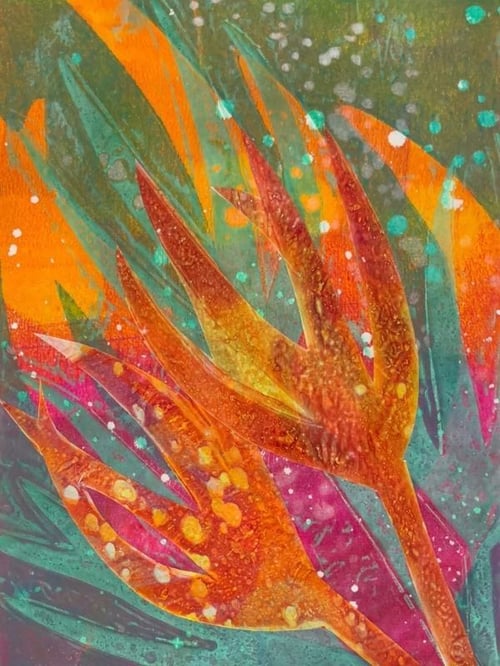
The Facebook community became a meaningful part of Amy’s experience, though not in the usual superficial sense of online participation. Amy enjoyed seeing what classmates were making, learning from Tara’s input, and following the development of work across the cohort.
More unexpectedly, that online connection became local. Amy met several artists in the same area and has since supported their exhibitions, learned alongside them, and joined a collage collective where people gather in person each month to work with gel-printed papers.
There was also another kind of encouragement at work in the group. Rather than feeling discouraged by artists who were further ahead, Amy found motivation in seeing what was still possible. Watching more advanced work emerge became a reason to keep going, not a reason to retreat. That is a subtle but powerful shift, and one that says a great deal about the tone of both the course and the artist.
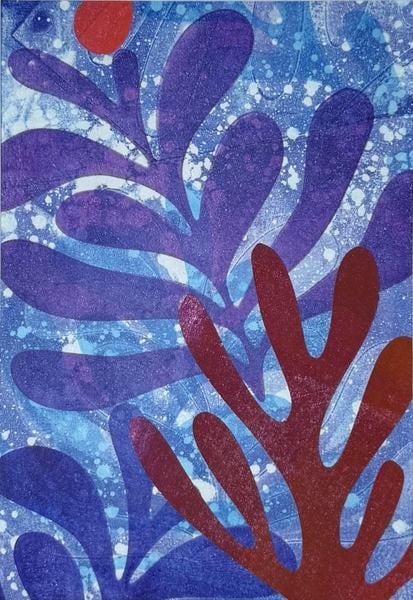
One of the most significant changes Amy describes is not purely technical. Before taking the course, Amy did not see herself as an artist. Art felt like something that required long, uninterrupted days and a level of freedom that life did not seem to allow.
Tara’s teaching quietly dismantled that belief. The course made it possible to work for an hour or two, then return later. An idea could be explored in stages. A thought could be left, then picked up again. Art became something that could live within ordinary life rather than outside it.
That practical permission changed more than Amy’s schedule. It changed identity. As Amy put it, “I didn’t see myself as an artist” before the course. Through the rhythm of the work and the way Tara encouraged small but regular creative engagement, that began to change.
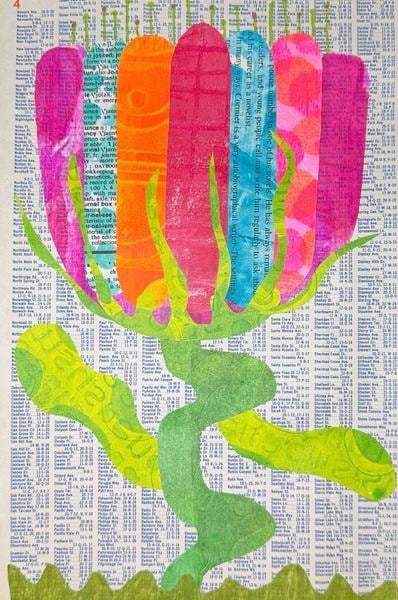
Another lasting aspect of Tara’s teaching was the encouragement to make the work personal. Tara shared artists for inspiration, introduced techniques and demonstrated possibilities, but always returned to the idea that the final work should be the student’s own.
That invitation had a visible effect on Amy’s way of seeing. Now, inspiration comes from neighbourhood walks, textures noticed in passing, objects glimpsed in galleries, and visual fragments collected through photographs. Amy is constantly gathering, observing and translating.
That shift matters because it signals a move from student to artist. The course did not simply teach Amy how to make better gel prints. It sharpened attention and made the surrounding world feel creatively available again.
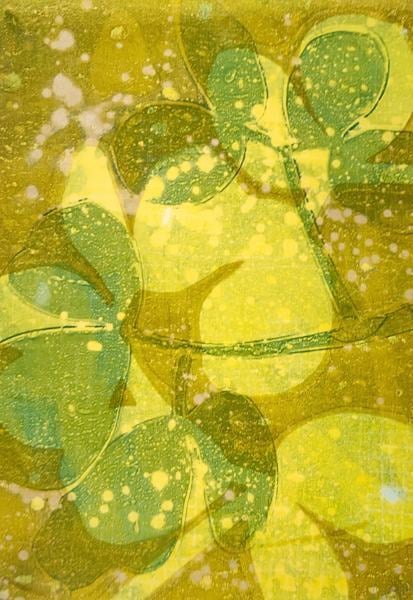
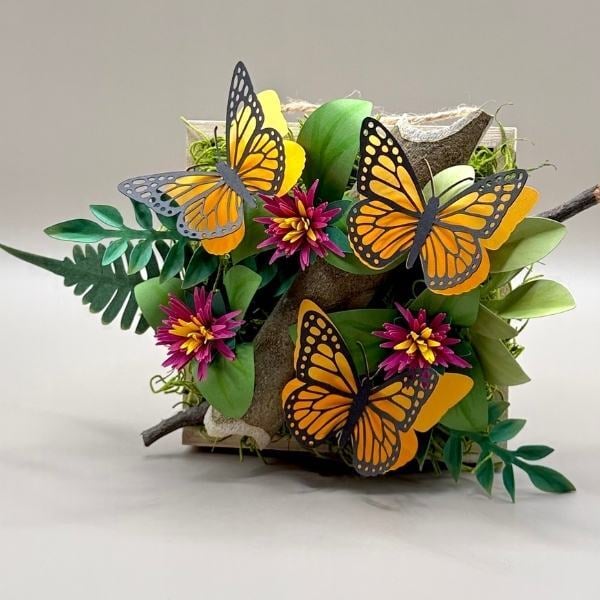
Amy’s recent work shows a practice in motion. Transparent deli paper prints, layered botanical impressions, collage pieces built from leftover fragments, block-printing experiments, and three-dimensional paper assemblages all speak to an artist who is expanding rather than narrowing.
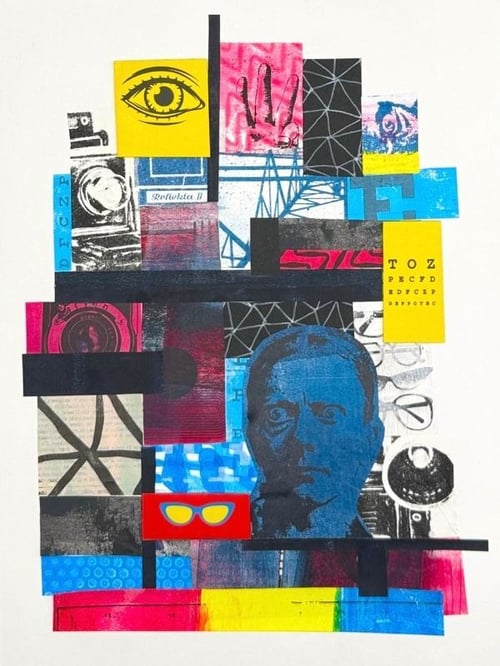
Some of that expansion came directly from the course. Amy had not seriously considered collage before, but as piles of gel prints accumulated, the possibilities became impossible to ignore. Even unsuccessful prints still held beautiful passages, and those fragments became the starting point for new work.
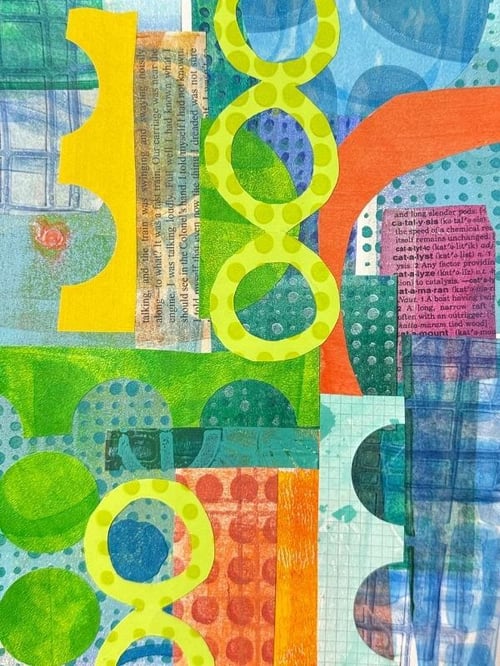
The course also introduced techniques that stretched Amy, both technically and conceptually. Bauhaus-inspired printing exercises, with their many transparent layers and careful reverse planning, were demanding and sometimes exhausting. But they also revealed just how much was possible within the medium. Amy describes loving the challenge precisely because it required such concentration.
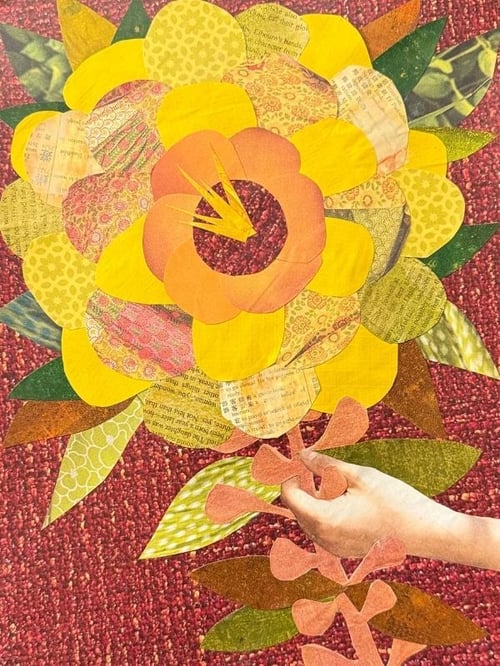
Amy is still making gel prints, but the practice has broadened. Collage, block printing and three-dimensional paper assemblage now sit alongside the original fascination with the gel plate. Just as importantly, Amy now has a broader network of artists to learn from and work alongside.
One direction feels especially alive at the moment: bringing gel-printed papers more fully into three-dimensional paper assemblages. The ideas are there, and the merge is not yet complete, but it is clearly on the horizon.
That sense of unfolding possibility may be one of the most valuable outcomes. The course did not produce a neat endpoint. It created momentum.
Amy’s advice to anyone considering Tara Axford’s course is simple and grounded in lived experience: do it. Not because it promises instant mastery, but because it offers a deeply practical way into making.
Amy emphasises that the course allows artists to move at their own pace, whether fast or slow, and that there is no need to force progress before it feels right. Just as importantly, there is the chance to meet an extraordinary community along the way.
For Amy, the course offered more than instruction. It offered a way back into creative life, one hour at a time.
1 min read
Ella Hayward is a multidisciplinary artist and art teacher based in the UK, with a creative life long intertwined with teaching, making and...
1 min read
Heather Miller is a mixed media artist living in Surrey in England, where her creative practice moves between acrylic painting, sculpture, collage,...
1 min read
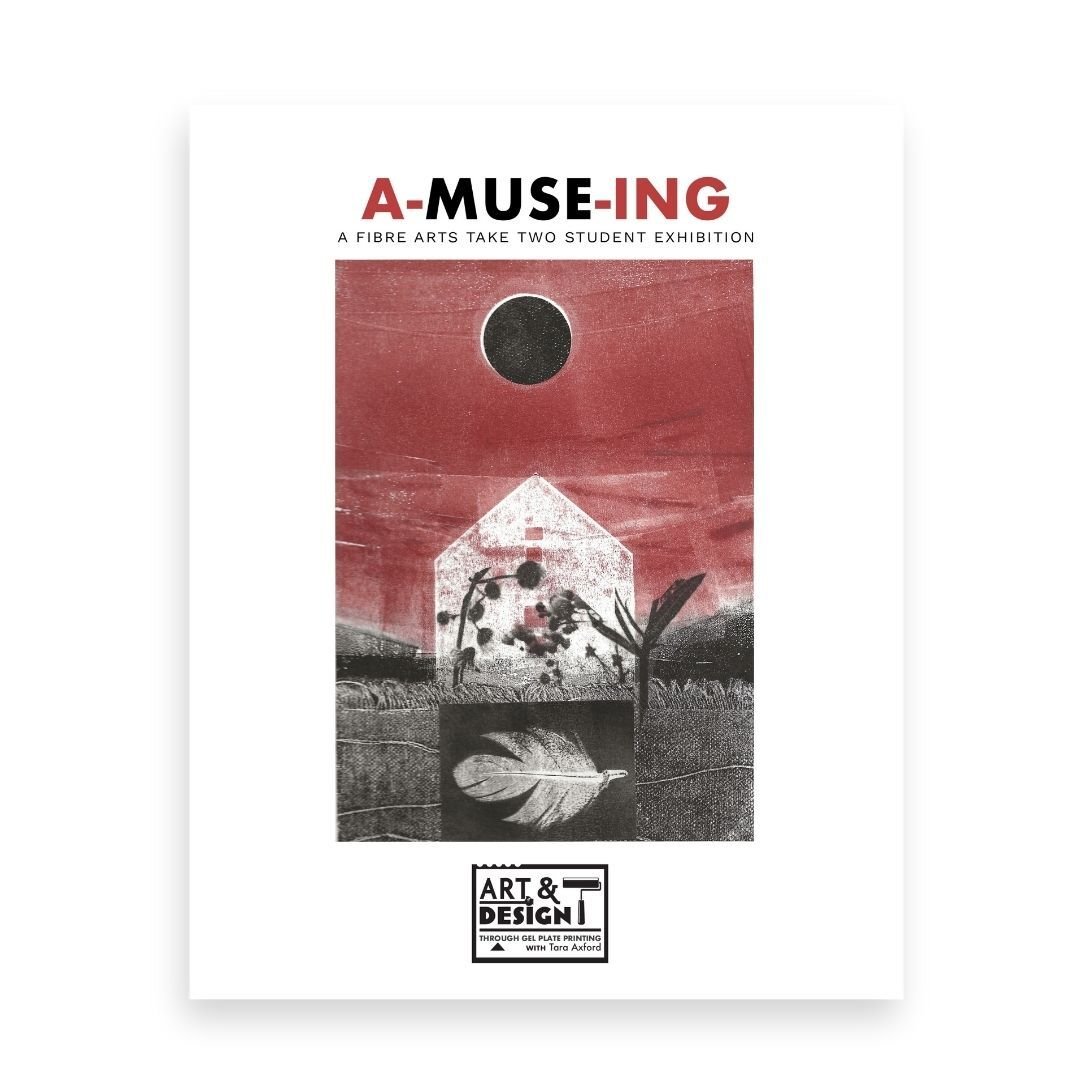
Student exhibition: Art & Design with Tara Axford "A-muse-ing is an exhibition celebrating the many interpretations of the word “muse.” In this case,...