-1.jpg)
For Caroline Higgs, art is not simply something that fills her time. Living in La Rochelle on the central west coast of France, she is now retired, but her creative practice remains a central part of her life. She describes stitching and making as something she naturally returns to, something that gives rhythm and purpose to her days. In her own words, art has become her “raison d’être”.
When Caroline enrolled in Claire Benn’s Out of This Earth course with Take Two, she was not new to textile work. She already had years of experience, a strong instinctive way of working and a deep connection to subjects such as water, rocks, trees and the natural landscape. What she was missing was not skill, but momentum. The course arrived at a point when she was searching for a way to reconnect with her practice and find a clearer direction forward.
When the momentum had gone
Before taking the course, Caroline was still creating, but something had shifted in the way she felt about the work. She had reached what she described as a hollow place, where the desire to make was still present but the impetus behind it had faded. She did not want to repeat familiar approaches or feel confined by a particular way of working, particularly because her practice had always been led strongly by instinct and emotional response.
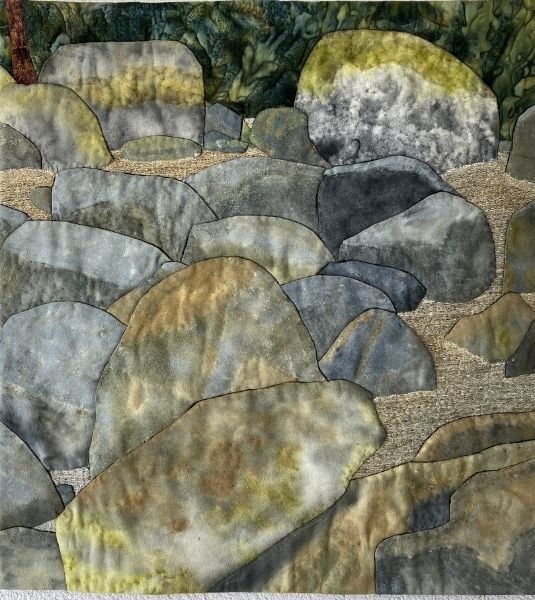
Caroline had long been drawn to the natural world and often worked from her own observations and photographs. One earlier textile piece, for example, was developed from an image of rocks in a river, with each stone individually painted, appliquéd and stitched onto a highly worked background to evoke the movement of water. This attention to texture and surface was already embedded in her practice, but she was struggling to understand where those interests might lead next.
She describes that period simply: “I was still creating, but my mojo had gone.” It was not that she had stopped being an artist or stopped making altogether. Rather, she had lost the sense of curiosity and possibility that had previously carried her into the next piece.
The pull of earth and natural pigments
Caroline discovered Out of This Earth through social media, although she no longer remembers exactly where she first saw it. What immediately caught her attention was Claire Benn’s focus on earth and natural pigments. The materials themselves felt different enough from her usual way of working to create a new sense of possibility.
That interest was enough to get her started, but she quickly found that the course offered far more than a new material process. During the summer, Caroline began spending her mornings in what she calls her “wet studio”, otherwise known as her garage, experimenting with pigments, surfaces and cloth. The work soon became part of her everyday rhythm and gave her a reason to return repeatedly to experimentation.
The unpredictable nature of pigment on cloth particularly appealed to her. Different fabrics responded in different ways, marks transferred unexpectedly and surfaces often revealed results she had not planned. For someone who had always preferred to work from instinct rather than detailed drawings or sketches, this sense of uncertainty felt natural rather than intimidating.
.jpg?width=743&height=404&name=Caroline%20Higgs%20-%20Student%20Sucess%20Story%20(8).jpg)
Permission to stop adding more
One of the most important moments in the course came through a deceptively simple comment from Claire: “You don’t have to stitch.” For Caroline, whose textile practice had long been closely connected to stitching, the idea initially felt completely unfamiliar. Stitch had become such an assumed part of the process that the possibility of leaving it out had barely occurred to her.
That comment changed the way she began to look at her work. Instead of automatically asking how stitch could be added, she started asking whether the work already said enough on its own. If a surface, mark or arrangement felt complete, there was no longer a need to continue working simply because that was what she had always done.
This became a significant shift in her creative thinking. Caroline began to recognise that textile work did not need to be defined by how much stitching it contained, and that restraint could be just as important as addition. It gave her greater confidence to respond to what was actually in front of her rather than following a familiar formula.
Learning to follow the unexpected
The course introduced Caroline to a wide range of processes, but what stayed with her most strongly was the way those processes encouraged experimentation. She was particularly excited by making a cola pen and discovering how freely she could create line on fabric. She also became fascinated by using textured objects beneath cloth, applying pigment and observing how marks travelled through or remained on the surface.
Ordinary objects began to take on new possibilities. Packaging, cardboard and other textured materials found their way into her garage because she started looking at them differently, wondering whether they might create an interesting print. The process was less about collecting techniques and more about developing a heightened awareness of what a surface or object could offer.
This openness to surprise suited Caroline’s natural way of working. She does not typically begin with detailed preparatory drawings, preferring instead to respond to what develops as she makes. The course strengthened that approach and gave her more ways to trust unexpected outcomes rather than trying to control them.
.jpg?width=600&height=600&name=Caroline%20Higgs%20-%20Student%20Sucess%20Story%20(5).jpg)
A work that revealed its meaning afterwards
Caroline’s final exhibition piece became a strong examplÏe of this new way of working. The piece was developed through folding and printing, moving through several different stages before it began to take on a life of its own. Although she had an idea in mind while making it, the final meaning only became clear once she stepped back and looked at what had emerged.
The work reminded her of the forest fires experienced in parts of France, particularly areas where peat can continue to burn beneath the ground even after the surface fire appears to have been extinguished. The marks suggested scorched trees, lingering smoke and heat still active below the surface. What had begun as an experimental surface suddenly became connected to a very specific visual and environmental experience.
Importantly, the finished piece contained no stitching. Caroline could not see anything that stitch would add, so she chose to leave it alone. That decision reflected one of the clearest changes brought about by the course: a greater willingness to recognise when a work was already complete.
.jpg?width=600&height=800&name=Caroline%20Higgs%20-%20Student%20Sucess%20Story%20(4).jpg)
An online course that felt complete
Caroline found the online structure of Out of This Earth particularly strong. Claire’s detailed resource guides became an important part of the way she worked through the material, and Caroline printed them out, placed them into a folder and added her own notes as she watched the lessons. She still refers back to those pages now.
For Caroline, the written information and filmed demonstrations worked closely together. The videos were clear enough that she felt able to follow the processes closely, while the resource guides gave her something practical to return to later. She found that the information provided was comprehensive enough that she rarely needed further clarification.
The filming itself also contributed to the sense of connection. Caroline describes the demonstrations as clear, enjoyable to watch and detailed enough to create the feeling of working alongside Claire. For an artist learning remotely, that sense of proximity made the online format feel much more personal.
Encouragement without being told what to do
Claire’s teaching approach was another part of the course that Caroline valued highly. She appreciated the fact that feedback was available and supportive, but never felt prescriptive. Rather than telling students exactly what they should make, Claire encouraged them to test ideas, take risks and continue developing their own responses.
Caroline found that directness motivating. She did not need someone to tell her whether every decision was right or wrong, but she did value having someone encourage her to keep going and try something she might otherwise have avoided. That balance suited her well as an experienced maker who wanted guidance without losing ownership of the work.
The student community also added another valuable dimension. Because Caroline lives and works alone, being able to share work, receive feedback and see how other artists were responding to the same course material gave her a sense of connection that was often missing from her everyday practice. She particularly enjoyed watching other students’ ideas develop over time and seeing how individual approaches emerged from the same starting points.
.jpg?width=600&height=600&name=Caroline%20Higgs%20-%20Student%20Sucess%20Story%20(6).jpg)
The exhibition as a reason to keep going
At the end of the course, students were invited to submit work to the Take Two online exhibition. Caroline initially felt some pressure around the timing because the exhibition followed relatively soon after the course ended, but she soon recognised that this deadline served an important purpose. It kept the momentum moving and gave her a clear reason to continue developing the work.
She also appreciated that every student had the opportunity to participate. For those who might not yet feel confident exhibiting, the online format created a more accessible way to share work publicly and take that step. Caroline wanted to submit something that had not already been widely shared, which gave her another reason to keep experimenting.
The exhibition therefore became more than an endpoint. It acted as a bridge between learning and independent practice, helping Caroline move from guided experimentation into work that she was prepared to present as her own.
Building a practice around pigment
Since completing the course, Caroline’s way of working has continued to evolve. While she still uses paint and chemical dyes when they are appropriate, earth pigments have become a much stronger foundation within her practice. She is also increasingly drawn to recycled fabrics and to ways of working that feel connected to natural materials and processes.
Rather than beginning every piece from scratch, Caroline now keeps a stock of cloth that has already been worked with pigment. When a new idea begins, she returns to those surfaces to see whether one might suggest a direction, atmosphere or starting point. This has created a more fluid way of working, where earlier experiments can remain useful long after they were first made.
The influence of Claire’s methods has also continued through Caroline’s later work and exhibitions. She has since taken another of Claire’s courses and begun incorporating text into her surfaces, including repeated lines from poetry to create visual texture. These developments feel less like separate techniques and more like an ongoing expansion of the creative permission she first encountered through Out of This Earth.
.jpg?width=600&height=800&name=Caroline%20Higgs%20-%20Student%20Sucess%20Story%20(2).jpg)
Finding a new centre
Looking back, Caroline believes the course gave her something more valuable than a set of techniques. It helped her rethink the foundations of her practice and gave her a new point from which to build. The creative hollow she had experienced before enrolling was replaced by a much stronger sense of direction.
Her work now begins from a broader range of possibilities. Pigment, recycled fabric, text, surface and print can all become starting points, and stitch is now something she chooses rather than something she automatically assumes must be present. That shift has made her practice feel more open and more responsive.
Perhaps most importantly, Caroline has regained the sense of curiosity that had been missing. She continues to exhibit and to develop new work, with the methods introduced through the course now firmly integrated into the way she thinks and makes.
Caroline’s advice to future students
For anyone considering Out of This Earth, Caroline’s advice is grounded in her own experience of arriving at the course unsure of where her work was heading. She believes the real value lies in being willing to experiment and in allowing yourself to work differently from the way you may have worked before.
She also encourages artists to remain open to materials they may not have considered, particularly earth pigments and more natural processes. For Caroline, working this way has become both creatively satisfying and closely aligned with her interest in recycled fabrics and environmentally conscious choices.
Her final advice is simple: “Go for it.” For Caroline, taking the course restored momentum, opened new possibilities and gave her a creative centre she continues to build on today.