1 min read
Juz Kitson: Contemporary art talk
While completing her honours at the National Academy of Arts, Juz Kitson’s work was acquired by David Walsh for MONA, the Museum of Old and New Art...
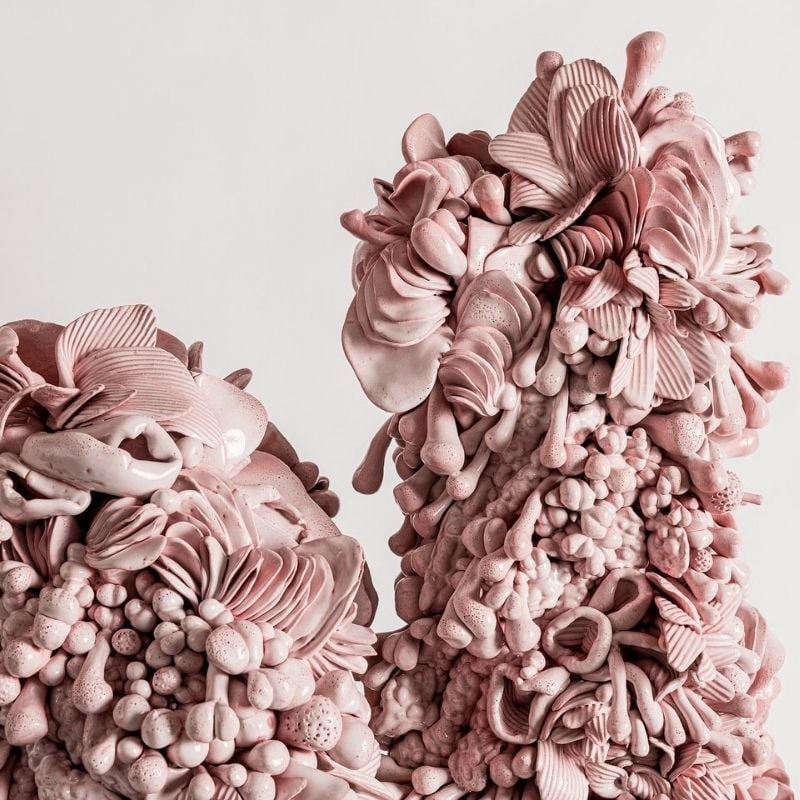
Ask ten people what contemporary ceramics is, and you'll likely get ten different answers. For some it's a functional bowl made with a fresh eye. For others it's a room sized installation that has nothing to do with dinner at all. Both can be true.
At its simplest, contemporary ceramics is an art form that explores ideas, rather than just function, using clay. It still involves the same fundamentals as traditional pottery, wedging clay, building form, firing and glazing, but the intent is different.
For example, a contemporary piece isn't trying to hold your soup. It's trying to say something, whether that's expressing a memory, a view on climate change, identity, or grief, in much the same way a painter might use oil, or a writer might use language.
A cup needs to hold liquid. A bowl needs to sit flat. Contemporary ceramics don't carry the same obligation – a piece can be entirely non-functional, deliberately fragile, or scaled far beyond anything you'd put on a table.
You'll find ceramic artists working alongside sculpture, installation, textiles, and even activism, using clay for what it can say, rather than what it can hold. In these cases, imperfection is often welcomed rather than corrected: a crack, a slump, or an unglazed patch can carry as much meaning as a perfectly thrown curve.
Plenty of contemporary ceramicists trained in traditional techniques first, and they still lean on that foundation. They've simply put those same skills to a different purpose.
Some contemporary ceramics work is deliberately ephemeral: left unfired, allowed to dry and crumble, or installed directly into a landscape where the weather and the ground are part of the piece. The making itself, and the choice to let something go, can be as much the artwork as the object left behind.
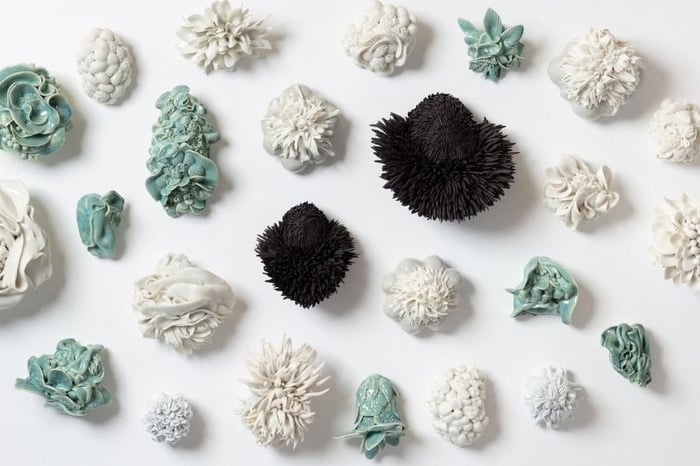 Artwork by Juz Kitson
If you already work in fibre, mixed media, or textiles, contemporary ceramics might feel more familiar than you'd expect. Many of the same instincts apply: building something by hand, layering materials, and letting texture carry meaning. Clay simply adds a new physical language to that vocabulary, one with its own resistance, timeline, and its own kind of magic.
Australian sculptor Juz Kitson works right at that intersection. Her practice sits at the meeting point of porcelain and unexpected natural materials, brought together to explore life, death, desire, and regeneration. It's ceramics with real conceptual weight behind it, not just skilled craft, but thinking made physical."
If you already stitch, weave, or layer paper and paint, you already understand the patience clay asks for. A coil takes shape the same way a row of stitches does, one considered addition at a time, and the willingness to let a material misbehave a little is just as valuable in porcelain as it is in cloth.
A few more artists working in clay right now show just how far exploring ideas can take you. These artists have been an influence and inspiration for Juz Kitson, and she talks about them in her course, Curious Matter.
American ceramic artist Linda Nguyen Lopez turns everyday, overlooked objects, dust, lint, an old iron, into strange, tender porcelain sculptures. Her pieces often look faintly alive, as though they're breathing or waiting to be noticed.
Lopez, who is of Vietnamese and Mexican descent, often draws on her own heritage and the objects that quietly accumulate around a life. Her sculptures have been shown at the Smithsonian American Art Museum and the Crystal Bridges Museum of American Art, among many others. She's a great example of contemporary ceramics turning the ordinary into something worth stopping for.
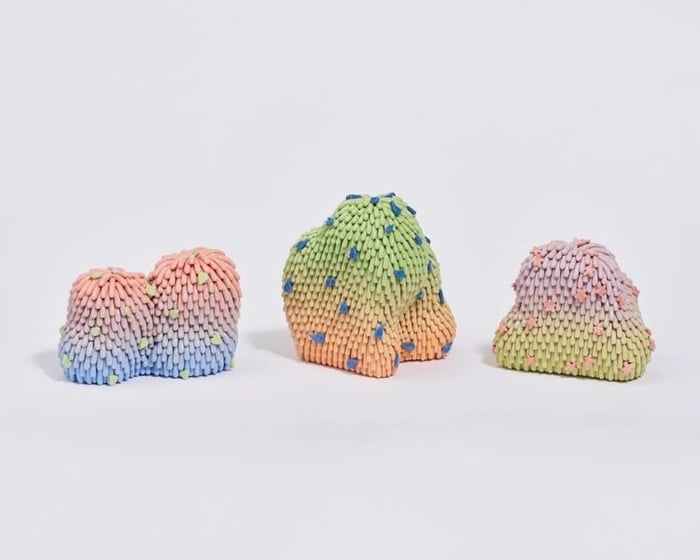 Artwork by Linda Nguyen Lopez
Courtney Mattison sculpts coral reefs in vivid, intricate detail, entirely from ceramic. Her large scale installations are both a celebration and warning - with glazed and colourful beside bleached white porcelain, as a direct response to the damage warming oceans are doing to reefs.
Mattison has a background in marine ecology as well as ceramics, and her work has been installed at the US Embassy in Jakarta and the NOAA headquarters in Washington, D.C. Her practice shows how contemporary ceramics can carry a message well beyond the studio, using the material itself, calcium carbonate, the same substance that builds real coral, to make the point land.
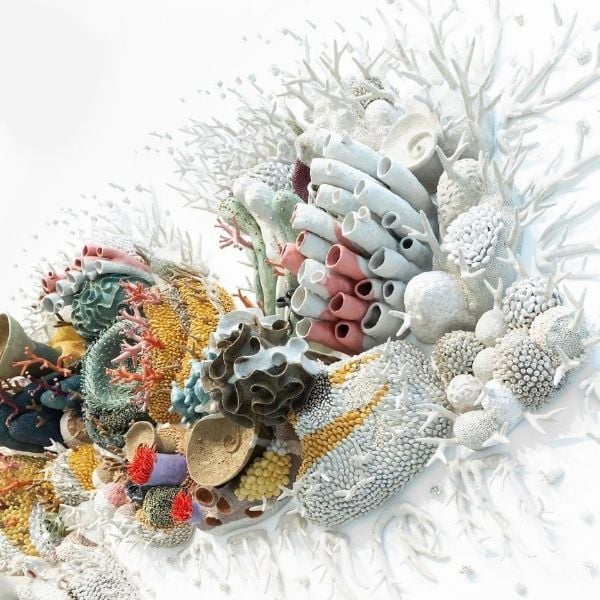 Our Changing Seas IV - Artwork by Courtney Mattison
English ceramicist Edmund de Waal is known for installations of small, pale porcelain vessels, often arranged by the hundreds inside cabinets, shelves, or purpose built structures. Individually, each pot is simple. Together, they become something closer to a piece of music or a sentence, exploring memory, collecting, and loss.
De Waal apprenticed under a traditional potter before developing his own minimalist style, and his work sits at the meeting point of British studio pottery and Japanese ceramic tradition. He's also a celebrated author, and his writing on porcelain's history is worth exploring if this kind of work interests you.
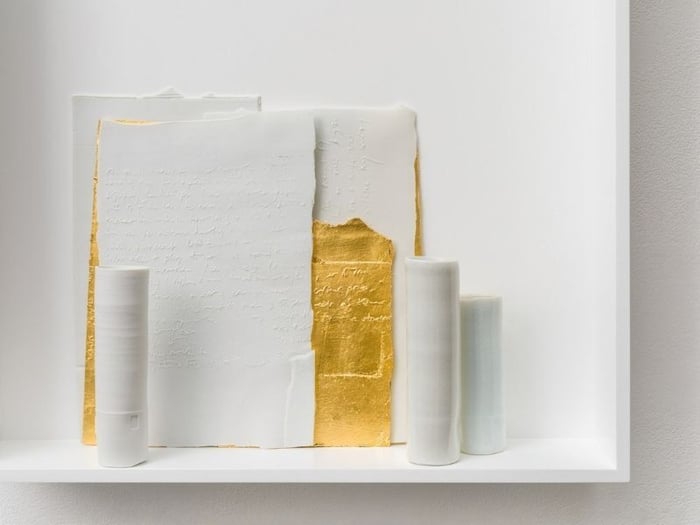 Close up of From yourself to yourself (2026) - Artwork by Edmund de Waal
Chris Gryder's ceramic wall pieces read more like geology than pottery. He creates relief tiles that resemble fossils, coral, or rock formations. Using a technique he developed himself, he carves a mould from sand and clay, then casts and slowly excavates the piece as the mould dries.
His work draws on the life sciences as much as art history, and it's a reminder that contemporary ceramics doesn't have to look like anything you'd recognise as a container. Sometimes it even looks like something the earth might have made on its own.
 Plane Happenstance, artwork by Chris Gryder - Wall Relief Sculpture
All these artists work in very different ways, but they share something: a willingness to ask what clay can do beyond its traditional job.
You don't need a pottery wheel or years of technical training to begin. Many contemporary ceramic artists start with clay handbuilding: pinching, coiling, and slab work that lets you shape porcelain by feel rather than by machine.
From there, it's about experimentation: What happens if you combine clay with a material you already love working with? What does the surface want to do if you stop trying to control it? There's no single correct entry point, and plenty of well-known contemporary ceramicists came to clay after years of working in another material and medium.
A few starting points worth trying:
Begin with clay handbuilding rather than the wheel. It's more forgiving, and closer to sculpture than to production pottery.
Let one other material into the work. Use a fibre or found object - anything that already feels like you.
Study a piece you're drawn to. Then ask what idea it's carrying, not just how it was made.
Make something that isn't functional. That's often where contemporary ceramics gets interesting.
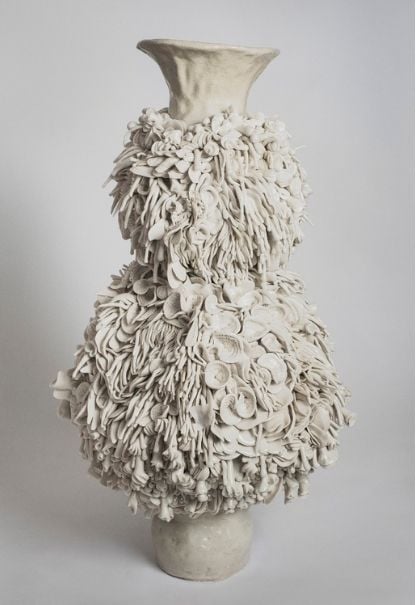 Artwork by Juz Kitson
Learning directly from an artist who's already fluent in this space can shortcut a lot of trial and error. Our course with Juz Kitson, Curious Matter, is perfect for you to learn, experiment and create new expressions in clay. Juz shares her handbuilding techniques and process for developing conceptual depth. This will help you translate instinct into form using porcelain and mixed media, the same way she does in her own studio.
She also embraces the ephemeral side of the material firsthand, with not every piece needing a kiln, and some are made to be installed outdoors and left to change, or simply dry, rather than fired and kept forever. Her practice draws on many of the same instincts you'll find in Lopez, Mattison, de Waal, and Gryder: using clay to say something that couldn't be said any other way.
Contemporary ceramics really isn't about clay. It's about what you're willing to say with it.
Whether you've never touched porcelain, or you've been working in fibre and mixed media for years, the material rewards curiosity more than perfection. If you pick it up expecting to make something a little strange, unfinished, or too honest, you're already closer to the spirit of it than you might think.
If this has sparked something for you, you can learn Juz's approach directly in Curious Matter, her contemporary ceramics course with Take Two.
1 min read
While completing her honours at the National Academy of Arts, Juz Kitson’s work was acquired by David Walsh for MONA, the Museum of Old and New Art...
.png)
1 min read
 Angela Truscott : Apr 17 2026
Ceramic artist Juz Kitson creates visceral, hybrid sculptures that blur the line between human, animal and object. Working across porcelain, found...
1 min read
Stephanie Outridge Field is a ceramic and multimedia artist whose journey spans over four decades of dedication, exploration and innovation....
1 min read
Angela Truscott : Feb 6 2026
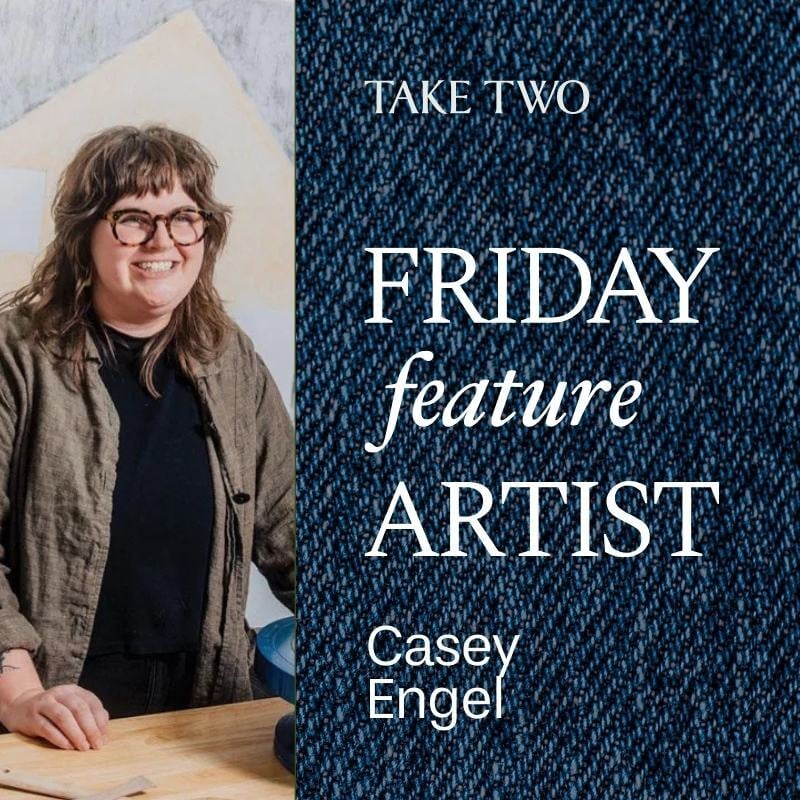
In this episode, quilter and multidisciplinary artist Casey Engel moves between fibre, ceramics, printmaking and painting – chasing that...